This past Christmas, Santa (that would be me) left me a bird feeder kit under the tree. I was pretty excited about it, imaging all the birds I would be able to watch from the comfort of my home. But once I got it out there, I realized that I'm gone from the house most of the daylight hours during that time of the year. Also, I wasn't getting many birds at the feeders, so I moved the setup near the back fence as was suggested on one of the feeders. It reasoned that birds would feel safer if the feeders were closer to trees and bushes where they could quickly seek shelter. That did help, but now the feeders were further from view.Today, I realized that the change to daylight savings time allowed me a little time after work to keep an eye on the feeders. Tonight I saw Bushtits at the suet feeder for the first time; as many as five at a time.
 Just before I reached the end of the auto tour at RNWR on Friday I noticed a Great Blue Heron to my right. A snake was dangling from its bill. I've watched Great Blue Herona catch fish and rodents, but this was the first time I had seen one with a snake.
The snake, however, wasn't going to give up on life as easily as the fish or rodents as it located a reed with its tail and wrapped it around it as tightly as it could.  The Heron pulled repeatedly as hard as it could, but the snake was not giving in.
 After a minute or so of pulling, the reed finally gave in and snapped.
 The Heron, thinking it had succeeded, tried to swallow the snake, but the snake still had a hold of the reed. Since the reed was at a right angle to the snake, it blocked the last bit of the snake from sliding down the Heron's throat.
 The Heron continued to work at swallowing the snake, maneuvering the reed around to the front of its bill.
 And around to the opposite side of its bill, slowly working the snakes grasp further down the reed.
 Until the snake finally lost its battle, the reed fell to the ground and the Heron swallowed the snake down. I wonder what it feels like to have a snake wiggling around in your stomach? :-)
To watch a video of a similar experience, check out this YouTube video taken by local photographer Dennis Davenport.
 A Northern Harrier on the hunt yesterday at RNWR.
 This Great Blue Heron held this pose the whole time I was taking pictures of the banded Canada Geese. I expected it to pluck a rodent off the ground at some point, but after 15 minutes I gave up and moved on. :-)

 This past Friday I saw these Canada Geese with bright red neck collars at RNWR. I have gotten pretty good (I think) at separating out the Canada from the Cackling Geese, but I haven't really tried to determine the subspecies of each of these species. These Canada Geese, however, seem to be good candidates for a Dusky Canada Goose subspecies based on their dark breasts (notice the difference in breast coloration of the lead bird on the left in the top image with the rest).One of the great things about finding birds with bands, in addition to finding out some of its history, is that you can find out its subspecies if one exists. So I have submitted these neck band codes to the USGS and will find out if my ID is correct. I was able to make out seven band codes by searching through the 62 images I took of the birds.I had another experience with neck collars this past December when I came across some banded Tundra Swans, again at RNWR. I submitted three codes and received certificates with the banding information in about a week.


 As you can see, two of the Swans were banded by Ms. Susan Savage on 7/20/2009 in Alaska, while the other was banded by Ms. Kristine M. Sowl on 7/26/2007 in a different part of Alaska. The thing that jumped out at me when I received these certificates, was that the Swans were identified as Whistling Swans. At the time, Tundra Swans were new to me and I was trying to pick out a Trumpeter Swan amongst all the Tundras. I didn't realize that Tundra Swans are composed of two subspecies; the Whistling Swan and the Bewick's Swan. Bewick's typically can be identified by a large amount of yellow on the upper part of their bill, but there are variances that can make positive identification tricky.

 Winter Wrens like to hang low in the brush making it hard to see them and this one was no different. The difference in this case, however, was the brush. What is normally some type of foliage, was instead a pile of logs and large sticks. This left the Wren exposed for longer periods of time than is normal. The pile of wood was located below me as the trail rose up a bank with the beach below, so I was actually looking down on the Wren.

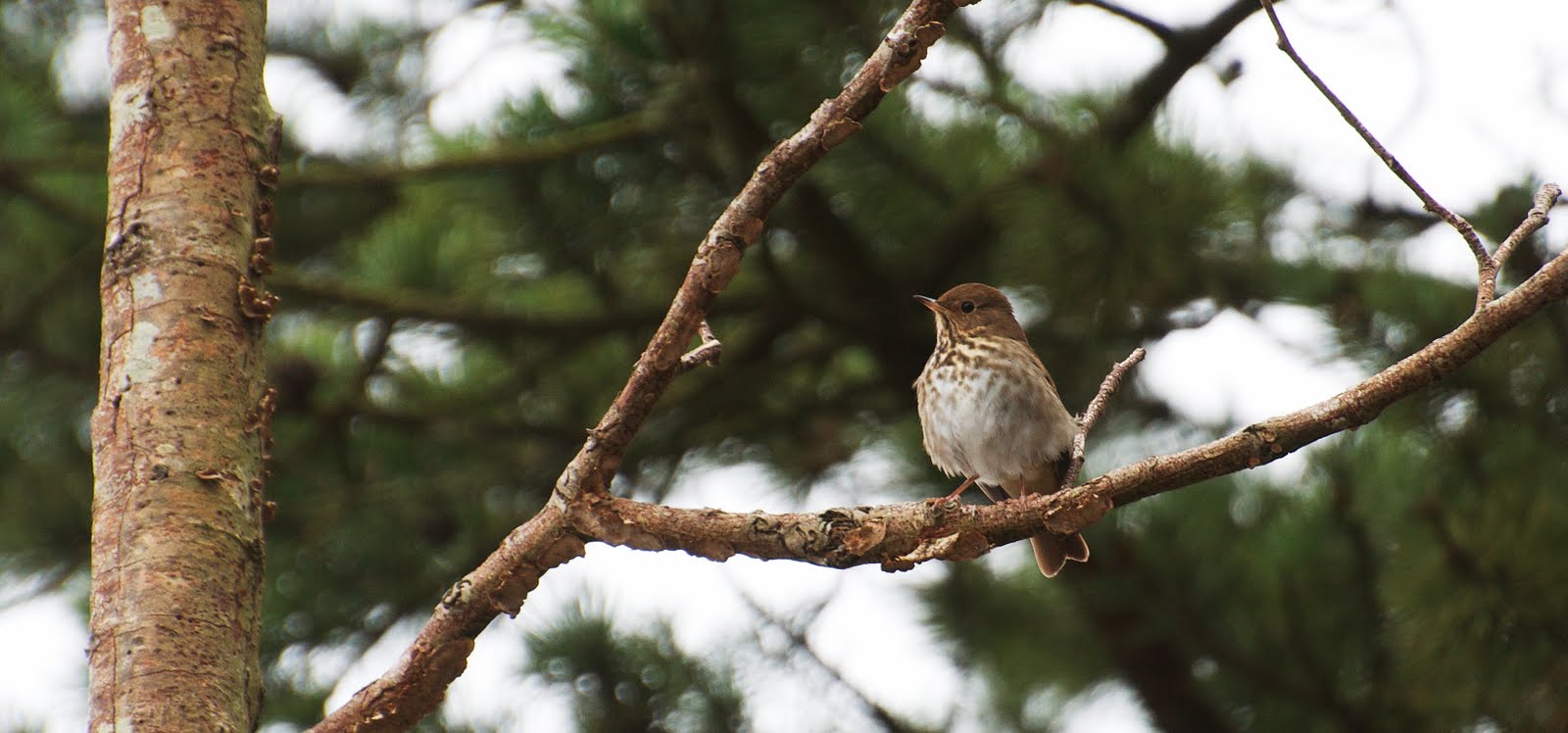
 While the beach side of Bayocean spit was slow, the Tillamook Bay side was pretty active. Along with the first winter Glaucous Gull and Red-necked Loons I've already posted, I saw Surf and White-winged Scoters, Horned and Western Grebes, Common Goldeneyes, Bald Eagles and an usually high number of Fox Sparrows and Hermit Thrushes.The Fox Sparrows and Hermit Thrushes started once the trail veered off the shore line and into the woods. I first saw four Fox Sparrows just off the trail scratching tirelessly through the dead leaves looking for food. While I was shooting the Fox Sparrows, the first of a series of Hermit Thrushes appeared, teasing me by only sitting still long enough to get a quick look, but not long enough to get a shot off.Then I noticed another Thrush just up the path. This one was a little more cooperative, letting me get a few shots. It was pushing mid afternoon by then and the clouds were getting heavier and the light dimmer, but I did manage to get a couple of shots that were good enough to post.While I don't know much about the singing of the Hermit Thrush, I found them similar to Song Sparrows in that all I heard them vocalize was a faint chirp. Nothing compared to the amazing songs they sing during the breeding season.


 There was supposed to be some sun Monday afternoon, but it came and went as I was on my way to RNWR. Activity was pretty slow for the refuge. Water fowl and raptors were few and far between, but there a few hundred Tree Swallows flying over South Big Lake. I've seen them there now for a few weeks and the numbers are increasing. I'm not sure why they seem to restrict themselves to that body of water.