Saturday, May 14, 2011

Tree Swallow - Mating

I spent the afternoon at Fernhill Wetlands today. It was quite active with birds, but not with the water fowl and shore birds that are seen regularly there. Instead, Passeriformes ruled the day. Warblers including Orange-crowned, Yellow and Yellow-rumps were common. Western Tanagers, Black-headed Grosbeaks and Cedar Waxwings were seen throughout. And the water was swarming with swallows; Tree, Barn and Cliff were all represented along with a few Vaux's Swifts sprinkled in.
As I approached the southern corners of Cattail Marsh and Eagle Perch Pond, I came across two Tree Swallows perched on the railing of the water flow cat walk. As I moved in closer, one of the swallows flew off. I swung around to the entrance to the cat walk when the swallow the had flown off, swooped down over what I assume was the female of the two. On its second pass, it lit atop of the female and they quickly mated and flew off.
Spring is definitely here!

Friday, May 13, 2011

Cinnamon Teal

Cinnamon Teal are one of the most common ducks at RNWR right now. I found this pair on Long Lake near marker 2 yesterday evening. I cropped it two different ways; one tight and one that included their reflections in the water. I think I like the tighter crop better. Feel free to leave me your opinion.

Marsh Wren

I've heard many and seen a few Marsh Wrens this Spring. They are difficult to shot since they are small, like to stay low in the reeds and don't stay still. I've had a couple of close encounters at RNWR. The images above were taken on two different visits during the past week.
The top image was near marker 10. It was just sitting out in the open on a branch. Rather unusual for a Marsh Wren in my experience. It had its back to me so most of the images were of the back of its head, but it looked back towards me nicely in this one.
The bottom image was taken about a week ago and is filed under "those that got away". This wren was taunting me by singing incessantly right along side my car, but rarely giving me a clear shot. This image was taken with it at its closest. Were it not for that blade of grass obstructing its head, it would have been my best picture of a Marsh Wren. Oh well, there will be other opportunities. :-)

Wednesday, May 11, 2011

American Robin

This Robin came hopping rather aggressively towards me as I was taking pictures of a California Towhee at Sutro Heights Park in San Francisco a week ago last Monday. It was rather odd looking and I thought it might be diseased, but looking at the pictures I think it had just gotten done bathing, although it looks as if its head and neck got the bulk of the water.

Tuesday, May 10, 2011

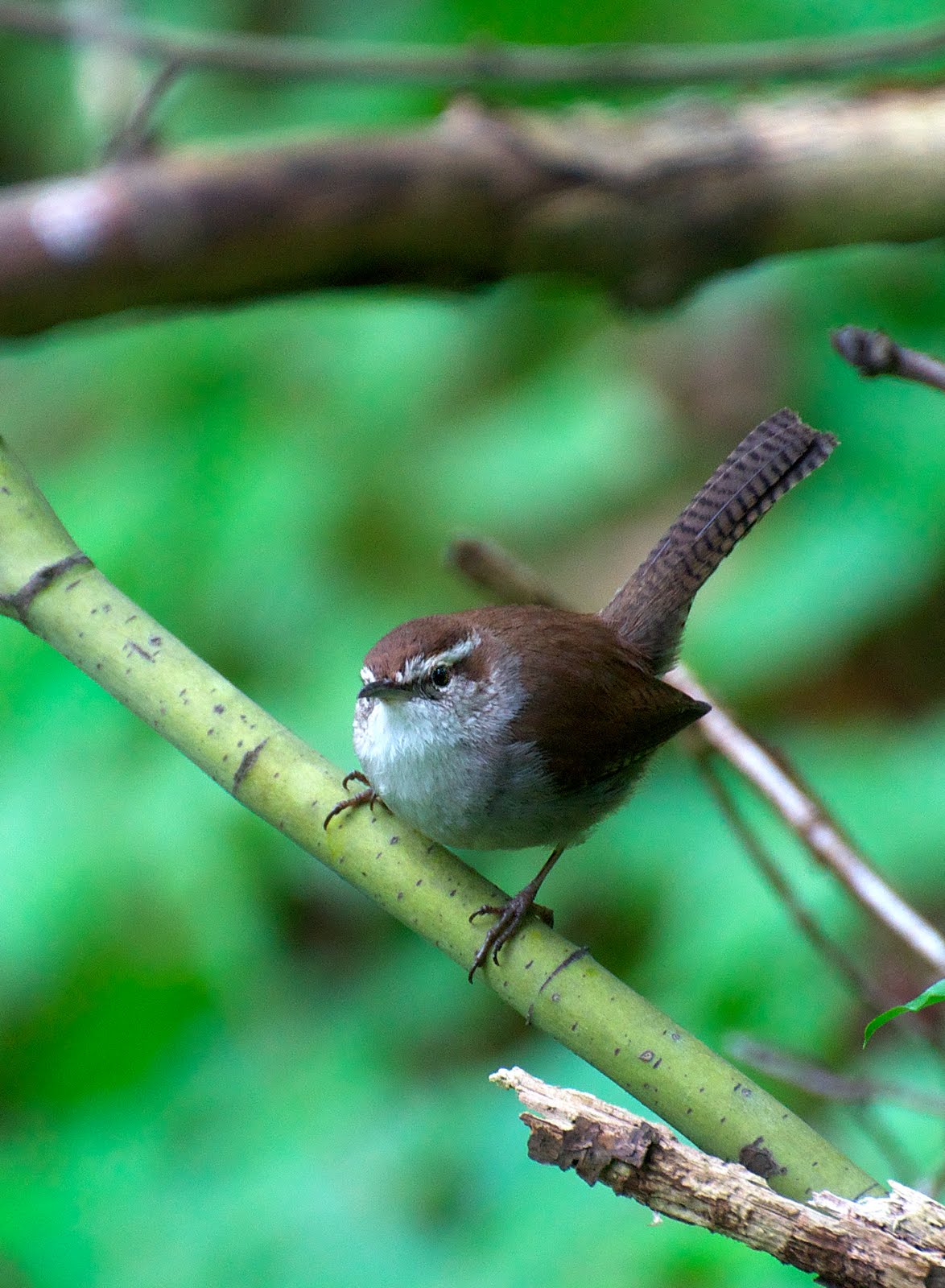
Bewick's Wren

After I took the picture of the female MacGillivray's Warbler in the last post, it flew up to the top of the bank along the road I was following. There was a washed out strip leading right to where it was, so I thought I'd climb up and see if I could get any closer shots. I did manage to get fairly close, but only for a moment and my attention was more on keeping my balance than taking a picture.
It turned out to be quite nice up there so I decided to hang out for awhile and see if it would come back. No luck with that, but a Bewick's Wren did came along and gave me a few good looks.

MacGillivray's Warbler

This past Saturday morning I decided to bird at Mount Tabor. There had been reports during the week that the warblers were migrating through so I thought I'd check it out.
While I heard a lot of bird song, I didn't see nearly as many birds as I had thought I would. In addition to the heavy foliage, I think the problem is that many of the birds are high in the trees. Since I am usually looking for close in opportunities for picture taking, I don't usually scour the tree tops for birds.
I did, however, see a few MacGillivray's Warblers. A new life bird for me! They tended to stay low and in the brush, but I did manage to get a couple of shots through the branches. The top image is a male with the dark throat, while the bottom image is a female with a pale throat.

Eurasian Blackbird

I thought I was done with birding on Monday, but after taking the train back to Zurich on Wednesday evening in preparation for an early flight back to the states in the morning, I found myself in my hotel at about 5:30 PM. Looking out my window, I saw some European Magpies flying between trees near the hotel and across the street in a parking lot. I realized that I was in a residential neighborhood so I decided to head out and try my luck.
At first I ran into private streets and was a bit disappointed, but then I noticed a playground and thought I might find a park. Better than that, I found a trail that followed a stream which wound its way through a large part of the city.
Along the way was a beautiful cemetery. It seemed that every plot was planted with colorful flowers. It was in this cemetery that I found some Eurasian Blackbirds. They are indeed black, but they aren't blackbirds. They're actually thrushes and are in the same genus with American Robins.
The female in the bottom image was behaving very similarly to a Robin, hopping around in the grass and pulling worms from the soil.
The male in the upper two pictures was singing some of the most beautiful bird songs that I have heard. In fact, this wasn't the only time that I had heard them, but it was the first time I had gotten good looks at the birds.
After some research, I found that these birds are the basis of the poem "Sing a Song of Sixpence".
It's also the subject of one of the Beatles' hits "Blackbird".

Sunday, May 8, 2011

Tufted Duck

So far, the birds I've posted from Switzerland were all from the late afternoon and early evening on the day that I arrived. I spent the next day, before beginning business meetings, across the lake, at a facility called Birdlife near La Sauge and the surrounding area.
Just outside the facility is a channel that connects Lac de Neuchatel with Murtensee, another nearby lake. This channel has many water fowl, including these Tufted Ducks. There have been sightings Tufted Ducks in Oregon this past Winter, but I was never lucky enough to get a chance to see one. Here in Switzerland they are much more common and I was able to get relatively close. They look a lot like a Lesser Scaup expect for the tuft on the back of their heads.

Friday, May 6, 2011

Mute Swan

The first thing I came upon when I reached the shore of Lac de Neuchatel for the first time were people feeding these Mute Swans. They slowly waddled up the sand to meet the people as they most likely do daily. What a change being able to see these large birds so close compared to the distant views I'm used to seeing of Tundra Swans around here.
The Swans where everywhere on the lake and they weren't very weary of people. They swam slowly and eloquently on the water striking gorgeous poses. Occasionally they would hold their wings slightly above their bodies as they swam as seen in the images above. Known as busking, it is evidently a threat display, mainly shown by males but also females to a small extent.

Thursday, May 5, 2011

Eurasian Coot

There were many Coots swimming in Lac de Neuchatel, only these were Eurasian Coots, not American Coots. Even so, they bore a strong resemblance to our common rail. The main difference is the large white forehead. In addition to it being fully white (the American Coot has a red dot at the top of the forehead) it had the look of a flatten piece of play dough stuck to it forehead.

California Towhee

I got a chance to bird in San Francisco Monday morning. I spent the time walking Lands End Trail and Sutro Heights Park. I saw an interesting mix of sea and land birds. The highlight for me and only new life bird were a few California Towhees. They tended to be a bit flighty, but I was able to get a few reasonable photos of this one.

Yellow-headed Blackbird

I've been doing a fair amount of travel lately, last week in Switzerland and this week in San Francisco, that I haven't had much time to do any local birding. So today I took a quick trip around the auto tour at RNWR.
It turned out to be a pretty good outing. I got my first photographs of a Yellow-headed Blackbird. I had gotten a quick glimpse of one last Saturday along Bruce Road at William L Finley National Wildlife Refuge, but wasn't able to get a shot off.
Today I saw Yellow-headed Blackbirds on both South Quigley Lake and South Big Lake. I'm not sure if they are common at RNWR or if just passing through, as I did not discover RNWR until late last Summer. I remember seeing them regularly as a kid in Minnesota.

Tuesday, May 3, 2011

White Wagtail

I eventually learned that there are ferry boats that run from village to village along Lac de Neuchatel all day long. I road on one on my way back from birding on the far side of the lake on Monday before my meetings began.
I took a moment to take a picture of this ferry as I was photographing the White Wagtail below.
It came walking on the rocks along the shore of the lake. I had found a comfortable rock to sit on as I watched birds nearby. This helped make it less leery of me, along with the fact that normal foot traffic made it used to people.
I've found that birds tend to be tamer in areas where people are common and are likely to drop food. These same birds in more isolated areas are much more likely to be scared off by a human.
As its name suggests, it wags its tail often. Another handsome European bird!

Sunday, May 1, 2011

Red-crested Pochard

It was strange to see so many new birds. I only saw four birds that I had seen before. Everything else was new. I imagine that it was this fact that made it seem that the birds were more colorful and had more beautiful songs. One of the more striking birds was the Red-crested Pochard seen below.
I saw this duck most everywhere I went. Though it is a member of the Family Anatidae, it shares no genus with any duck I've yet to see nor any duck in North America. While classified a diving duck, it apparently prefers to dabble.