Monday, February 28, 2011

Sanderling

I walked around Bayocean Spit near Tillamook on Saturday. It's quite a walk, about four miles each way. I walked the ocean beach side first. There weren't very many birds on the beach that morning, but I did get some great looks at some Sanderlings.
I saw two flocks fly by and one of them decided to land just in front of me. It's great fun to watch them scurry along the waters edge looking for small invertebrates. They follow the surf out and then come running back as it comes back in. I used this to my advantage, positioning myself near where they would end up as the water came in and kneeled down low to be less ominous. Sure enough, they came in very close to me.
Shortly after a Western Gull swooped in and landed not far from the action with a crab in its bill.
One of the Sanderlings took interest and started to move in.
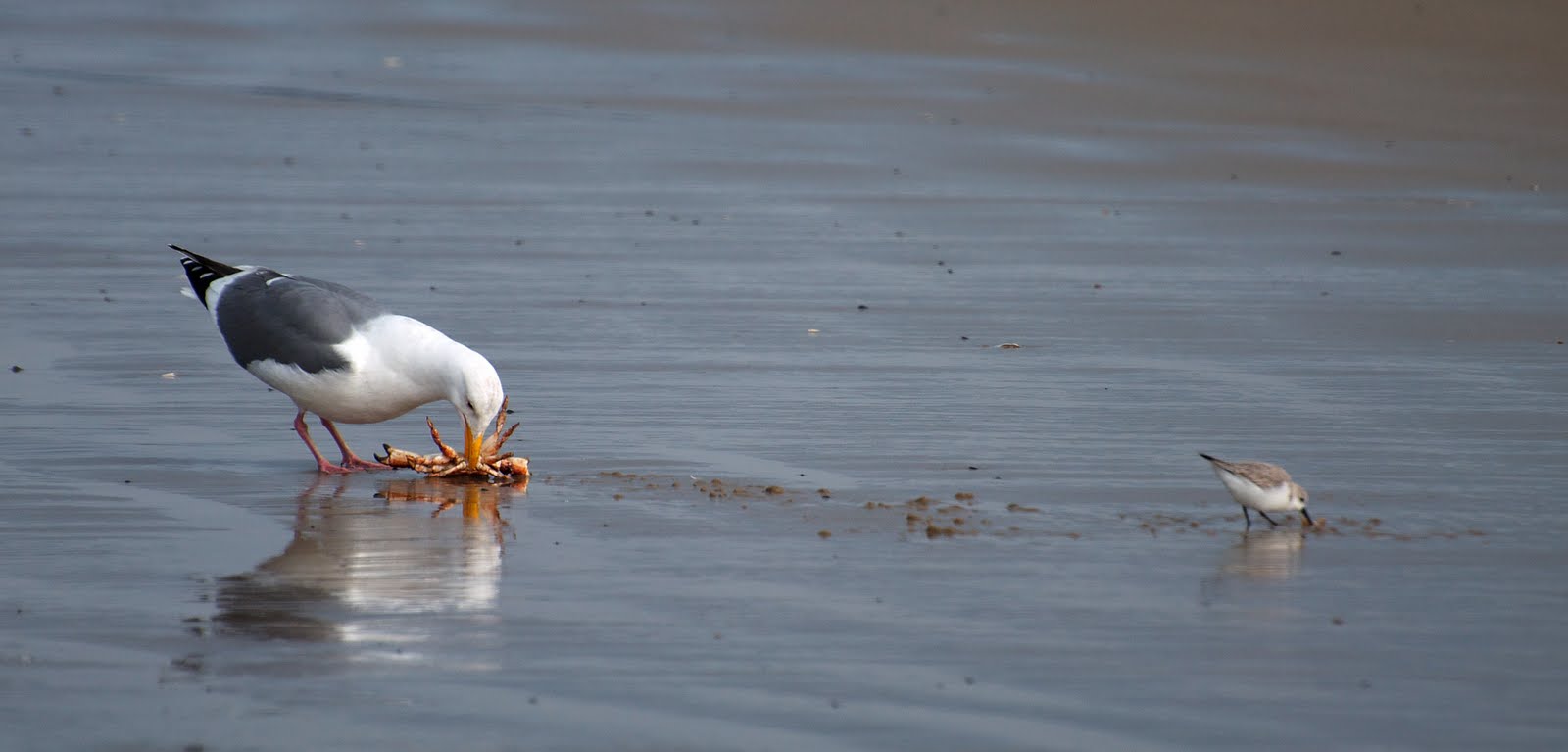
I inadvertently helped it out as I moved in by spooking the Western.
This gave the Sanderling its opportunity. While it showed interest and picked at the crab a little, it didn't start feasting.
Feeling bad for the Gull, I backed off and it eventually returned to the crab.

Sunday, February 27, 2011

Northern Shrike

I finally saw my first Northern Shrike. I took advantage of the sunshine on Friday afternoon and made a quick trip around the auto tour at RNWR. On the home stretch, I saw a bird fly in front of my car and land in the blackberry bushes to the right. I tried to position my car so that I could get a picture, but it flew off on the opposite side of the berm that runs along the road.
I took a chance that it might come back and drove up to the place it disappeared and waited. Sure enough, it flew up to the top of some branches of a bush. I was able to get a few decent shots of it before it flew off into the grassy area to the left and landed close enough to keep an eye on it.
I watched for a couple of minutes until it suddenly reached down and plucked a rodent up from the ground.
It only held on to it for a moment before it dropped it again and stood there as the rodent kicked. This lasted for what seemed like about a half a minute. I not sure, but it seemed like it was waiting for the rodent to die.It then scooped up the rodent and flew off.
It's interesting in that the rodent is almost as big as the shrike. I wonder if it eats it all itself or shares it. Northern Shrikes are typically solitary and does not breed here.

Saturday, February 26, 2011

Glaucous Gull - Paler 1st Winter

I thought I'd try to beat the cold today by going to the coast. :-) It's usually the other way around, but it was going to be very cold here today and the forecast indicated that the coast would be a little warmer. It was also supposed to be sunny. I'm not so sure it was much warmer, and it was hardly sunny, but I was well prepared for the cold and the wind was light.
I decided to go to Bayocean Spit and it turned out to be a pretty good day. For one, I saw my first Glaucous Gull. It threw me though as it turned out to be a paler 1st Winter juvenile. I expected a Glaucous to look a lot like a Western with a paler gray back and white wing tips. But, this one was practically all white except for a small amount of very pale brown speckles that I really didn't notice until it flew.
Besides the almost all white color, the other indication of a 1st Winter bird is the fact that it has a very dark eye.

Wednesday, February 23, 2011

Song Sparrow

The telltale signs of Spring are starting to emerge. Though I did not capture it in an image, this Song Sparrow was singing just moments before I took its picture at Wilsonville Memorial Park on Monday. It was a pleasure to hear over the raspy chirp they call a song in the Autumn and Winter months. Also note the leaves budding out in the upper right hand corner.

Monday, February 21, 2011

American White Pelican

There have been several reports of a couple of American White Pelicans over-wintering in a pond behind the Post Office in Tualatin. American White Pelicans usually winter in the deep southern states, Mexico and northern Central America.
On my way back from TRNWR on Monday, I decided to swing by and see if I could find them. Sure enough, they were napping on a small island in the middle of the pond (evidently it is called Hedges Creek Marsh).
What I found most interesting is how pale and pink their bills were. During the summer they are bright orange-yellow.

Sunday, February 20, 2011

White-crowned Sparrow

I spent the day yesterday helping my son and a team of dedicated and enthusiastic people donate 2 days of their time to make a movie for the 48 Hour Film Project. When I say spent the day, I mean the WHOLE day. I got up at 5:00 AM and didn't get home until after 1:00 AM Sunday morning. I provided the lighting for the shoot. It was a lot of fun, but between that and the lighting I did for Wilsonville High School's production of The Odd Couple, I haven't had a lot of time to bird.
I'm still working through all the pictures I took on my trip to Las Vegas. I didn't see a lot of Sparrows at the sites I visited and the one's I did see where mostly White-crowns like the one in the image above.

Friday, February 18, 2011

Clark's Grebe?

When I saw the Grebe above, I assumed a Western Grebe as it seems most I see are. Looking at these pictures again tonight, I've swayed myself into thinking that it is a Clark's Grebe. It's harder to tell them apart in the winter as the Western Grebe gets a little smudgy around the eye and the Clark's Grebe darkens above and to the sides of the eye, but I'm going mostly on field guide information than on experience.
Bill color is also an indicator, but isn't much help in this case, in my opinion, as the bill looks bright yellow in the sun and dark when it is shaded.
What's swayed me is the fact that the eye is only half covered with black, with some smudginess of the black around the eye. I may be wrong, I have been before, but that's my conclusion. As always, comments welcomed.

Thursday, February 17, 2011

American Pipit

These American Pipets were the last of the 10 new life birds I saw on my trip to Las Vegas last month. They were difficult to shoot as they stayed between me and the low sun and would never let me get very close.
In the image above, two Pipits sit on top of water main similar to the one I walked atop to reach the White-faced Ibis earlier in the day.

Wednesday, February 16, 2011

Northern Pintail

A male and female Northern Pintail seen at Clark County Wetlands Park in Henderson, Nevada on January 31. The male is really showing off its long and elegant neck in the top image.

Tuesday, February 15, 2011

Bewick's Wren

It had been awhile since I had visited Jackson Bottom Wetlands Preserve, so I decided a week ago last Sunday to see how the water levels had returned since fall. The water levels were good, but the birds numbers were just so-so; however it was mid to late afternoon.
I did manage to get this shot of Bewick's Wren. It was a typical cloudy, gloomy, low-light day, but this wren hung around in the open long enough and allowed me to get in close enough to get one decent shot.

Monday, February 14, 2011

Green Heron

I've taken better pictures of Green Herons, but it's been awhile since I've seen one and this Heron, while skittish like most, stuck around long enough and offered up some interesting poses, so I decided to post these images I took on the 6th at Fernhill Wetlands.

Sunday, February 13, 2011

Eurasian Wigeon

I visited TRNWR for the first time this year. The water levels have risen, but the birds were scarce. Very few passeriformes, water fowl numbers were down, but the Western Screech-Owl was at its perch.
The refuge has cleaned up most of the mess created by the fallen tree on the lookout platform at the end of the trail. As water levels creep up, the water fowl viewing is closer. Today I saw three male Eurasian Wigeons with a single female from the platform.

American Bittern

An American Bittern along the canal on the auto tour at RNWR between markers 12 and 13 in a classic pose. American Bitterns are common along this stretch, but you have to look closely or you might miss them hiding in the tall grass.

Saturday, February 12, 2011

Northern Shoveler - Male Eclipse or Juvenile?

There were several Northern Shovelers feeding in Canvas Lake very near the road just before marker 11 on the auto tour at RNWR Wednesday. I pulled over to the side and found areas that I could peek through the tall grass to take pictures.
The top image shows a male and a female in typical plumage for this time of year. The bottom image is either a juvenile male or an adult male that is very late in changing out of eclipse plumage. Two things point to a male; the sprinkling of green feathers on its head and the pale eye. Since the eye isn't bright yellow, I would tend towards this being a juvenile. Cornell's site states that adult males, in all forms of plumage, have bright yellow eyes.

Northern Pintail

I saw this pair of Northern Pintails feeding in the canal at RNWR not far from the Ring-necked Ducks I posted yesterday.
The male has a pinkish area in the brown foliage near the back of its head on both sides. I noticed that this is not uncommon as many pictures I found on the web had similar coloration. Cornell's Birds of North American states of the Northern Pintail's Definitive Alternate Plumage, "Most of head medium to chocolate brown with purplish sheen laterally,...". This doesn't necessarily look like sheen as it stays in the same place and didn't seem to change much with the sun's angle, but this may be the explanation.

Friday, February 11, 2011

Ring-necked Duck

Back in December I posted a couple of pictures of a female Ring-necked Duck that I saw at RNWR. I had seen it several times in the canal along the auto tour between markers 2 & 3. I mentioned that it would nice if it attracted a male into the canal so I could add a closer image of a male to my collection.
The female hasn't been in the canal the last couple of times that I visited, but on Wednesday it was back with not only a male, but a female Lesser Scaup.

Thursday, February 10, 2011

Red-tailed Hawk - Harlan's

I've seen a dark hawk near marker 13 on the auto tour at RNWR regularly for the past 2 or 3 months. It usually sits in a small tree quite a ways off the road so I have never been able to get a decent shot of it.
Since yesterday was such a beautiful, sunny day, I decided to make a quick trip to RNWR. I saw most of the usual birds including an American Bittern. The Swan numbers have dwindled down to just a few.
As I approached marker 13 I saw the dark hawk flying low in front of me. I quickly stopped the car and stuck my head and camera out the side window and got off one shot before it passed in front of me. The image turned out good enough to get a pretty good look at it. Based on the under wing (dark coverts and light primaries and secondaries with dark tips) and tail (light gray) coloration, this hawk fits a Harlan's subspecies of a Red-tailed Hawk.
I've been seeing reports of a Harlan's at RNWR on OBOL, so I assume this is the hawk.

Sunday, February 6, 2011

Cassin's Kingbird?

Here's another bird I saw on my Las Vegas trip that I am uncertain as to its identification. I can't decide if this is a Cassin's or a Western Kingbird. I tend to lean towards the Cassin's because of the defined white stripe on its throat and extending under its eye, even though there seemed to be a fairly large variation in this feature for both Cassin's and Westerns in pictures I found on the web. It's breast also seems to be a bit dark for a Western, but haven't seen a Western Kingbird since I was a kid.
Again, any feedback would be appreciated.

Crissal Thrasher?

Unfortunately this is the only picture I got of this bird as it was quite timid and quickly disappeared into some dense brush. It was positioned in a shadow when I took the picture so it was fairly underexposed. I was able to pull out a fair amount of detail with image editing, but with the angle being from the back, there is missing details that would help with its identification.
Based on what can be seen, I narrowed it down to three birds; a Crissal Thrasher, a California Thrasher or a Le Conte's Thrasher. These birds all have gray backs, rufous or buffy undertail coverts and a large, curved bill.
I eliminated the California Thrasher pretty quickly as Las Vegas is out of range and Sibley states that the two rarely overlap. That leaves the Crissal and Le Conte's Thrasher. Of the two, I have to give the nod to a Crissal Thrasher because of its apparent darker gray coloration and darker rufous undertail coverts.
Please feel free to comment one way or the other on my conclusion.

Friday, February 4, 2011

Snowy Egret

I've seen Snowy Egrets once before on the Rio Grande river in Albuquerque, NM last summer. They were standing out on sandbars in the middle of the river, so I didn't get very close looks. I did get pretty close to this Snowy Egret last Monday at Clark County Wetlands Park in Henderson, NV. Having seen Great Egrets many time here in Oregon, I was surprised that the Snowy's were quite a bit smaller. Sybley states that Great Egrets stand almost 40" while Snowy Egrets stand at only 24".
While these images don't reveal the black legs and bright yellow feet of the Snowy Egret, I did get some mediocre pictures of it flying away that did reveal this trait. That was the thing that struck me the most the first time I saw them. It kind of looks like they are wearing yellow shoes.

Thursday, February 3, 2011

Black-crowned Night-Heron

I saw two black-crowned Night-Herons while in Las Vegas. The first was at Henderson Bird Viewing Preserve seen in the top image. It was quite a ways from me, so I wasn't sure what it was as it looked like a big white blob. It didn't help that it initially had its head tucked away.
On my last day, before heading to the airport, I saw my first juvenile Black-crowned Night-Heron seen in the bottom two images. It came flying towards me from a bend in the stream I was following. I was hoping it was something a little more exotic, but I finally concluded that it was a juvenile Night-Heron. Still a nice find!

Wednesday, February 2, 2011

Black Phoebe

One of the Black Phoebes I saw at Henderson Bird Viewing Preserve this past Friday.

Tuesday, February 1, 2011

White-faced Ibis

While walking around the ponds at Clark County Wetlands Park in Henderson, NV, I saw some Double-crested Cormorants. The night before, I had been updating my list for Nevada and noticed that Double-crested Cormorants are common in the area, so I was happy to have seen some so I could check them off.
Not long after, I saw one flying towards me. As I was taking pictures of it approaching and it got closer, I got a better look at its bill and realized this was not a Double-crested Cormorant.
As I watched it fly past I hoped that it would land nearby so I could get a better look. Good luck was with me as it set down in some reeds not far from where I was.
As I approached the area I saw it come down, I noticed an entry into the reeds that had been formed when some sort of vehicle had driven through (There is a fair amount of improvements being done in the park). One thing I discovered about birding in the desert, is that most vegetation you might step on is most likely bone dry and will make quite a loud crunch, so I tried to be as quite as possible so I wouldn't scare it away it it did turn out to be up ahead.
Luck continued to be on my side as the path turned towards a small muddy pond where the bird was scavenging for food. Unfortunately, this is where my luck turned towards the worse. The angle was awful as the bright sun was behind the bird. None-the-less, I took some pictures, if for no other reason than to help identify the bird later.
But then I realized that if I turned back and proceeded further down the main trail, I could approach from the other side and have the sun front light the bird. I had to walk atop a large irrigation pipe to reach the pond and was able to do so without flushing the bird. The top two pictures are the result of this effort.
Once I got back to my room and looked in my field guide, I discovered that this was a non-breeding White-faced Ibis. This is the first Ibis of any type I have seen. It was quite an interesting bird.