I saw a Bonaparte's Gull on May 30 at Jackson Bottom Wetlands Preserve. It was floating on Pintail Pond, zigzagging back and forth looking for things to eat. Quite often it would thrust its head into the water in hopes of catching something. According to Cornell's All About Birds, it eats small fish and large invertebrates, including insects, so its actions were in line with its typical feeding habits.I wasn't able to get very good pictures of it as it stayed a ways off shore. I watched it quite awhile, using the tall grass that has grown along the service road that surrounds the pond as a blind, hoping it would come in closer, but it was satisfied with its position. The top image above shows the gull in one of the pictures I took uncropped at its closest using my 300mm lens (actually 450mm in 35mm film terms for those who understand that kind of thing). The image below it is a fairly tight crop. I typically don't like to crop that much as the resulting picture loses a fair amount of detail. None-the-less, there is usually enough detail for identifying and studying the bird.
Last November, I saw a couple of Bonaparte's Gulls along the South Jetty at Fort Stephens State Park. One was an adult and the other a first winter gull as seen in the image below: The adult's tail is completely white compared to the black tips on the feathers of the first winter. The tops of the wings of the adult are relatively clean with black tips on the primaries whereas the first winter gull's upper wings have mottled brown on the lesser coverts and on the leading edge of the primaries, plus black tips on the secondaries. Also, the wintering adult's black ear spot is fairly round as apposed to the oval ear spot of the first winter's. Of course, in the summer, during the breeding season, the head of the Bonaparte's Gull is completely black.
 Here's a better view of the first winter's upper wings and tail: That brings me back to the gull I saw a week ago. What can I tell about it from it's plumage? Well, from the image below, I'd say it is a first winter and it has obvious black tail feather tips. But this picture was taken on May 30th. According to Sibley's Field Guide, an adult should have a black head in April.
 Looking closely at the image, you will notice a few things. First, the mottling on the lesser coverts and lead edge of the primaries is nearly gone and the ear spot is more round than oval. Sibley states that it take a Bonaparte's Gull a year to acquire adult plumage. Therefore, I deduce that a first winter does not have a black head in late May like this one, but it is clearly transitioning towards adult coloring. And an even closer look at the back of its head reveals some darker feathers starting to fill in.
 Another bird from Switzerland. This was the first bird I took a picture of at BirdLife as I was walking to one of the blinds. It looks a lot like our Black-capped Chickadee and as one might suspect belongs to the same genus, Poecile.
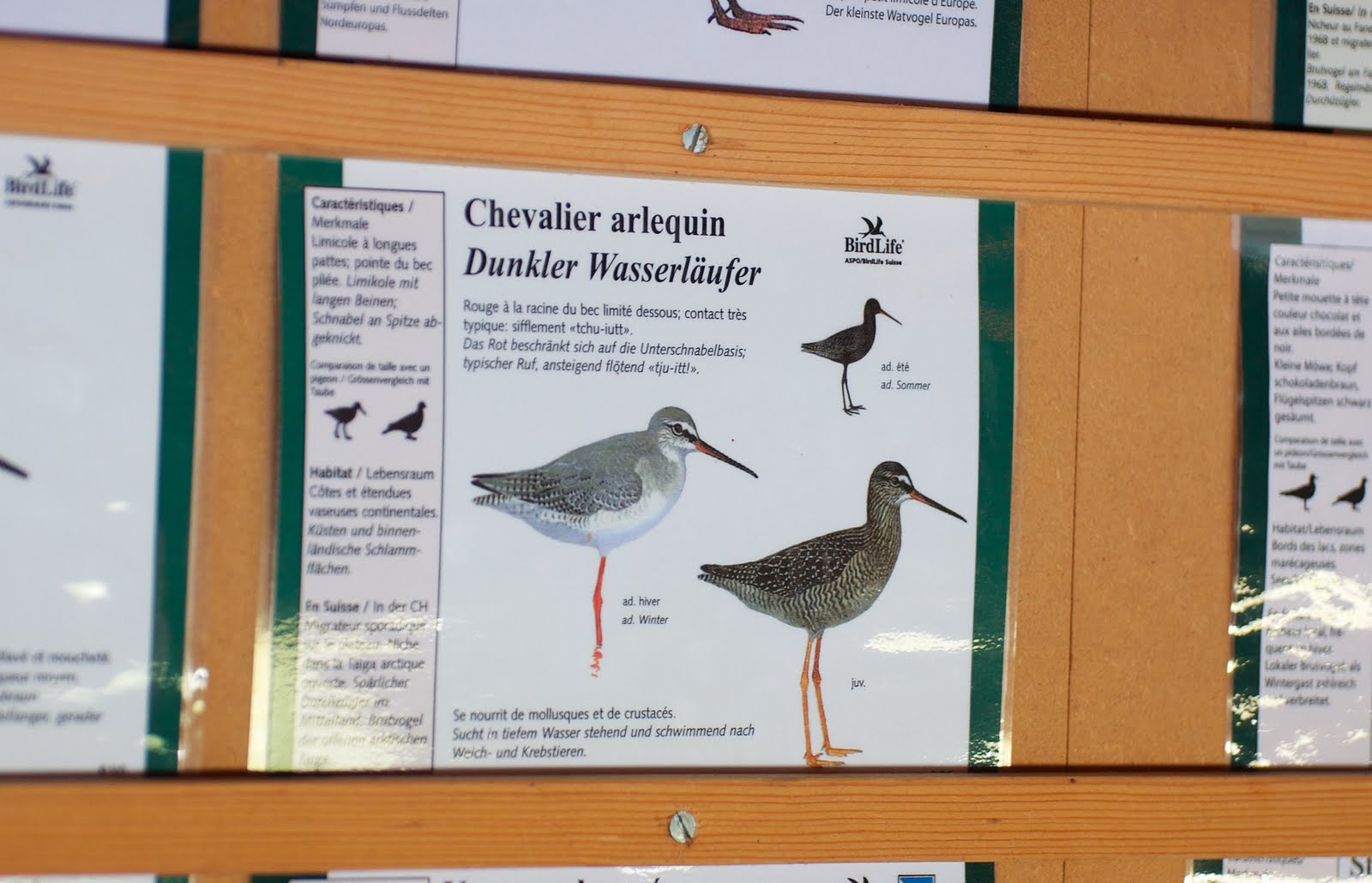
 In addition to posting sketches of birds in the bird blinds, there were also signs posted in various places. Check that bird out next to it on the sign. I would have loved to have seen that.All-in-all a very nice place to bird.
 I'm still nursing a cold. I can't gather the strength to get up in the morning. I slept about 13 hours both Friday and Saturday night. Went to immediate care this afternoon, just to be sure I didn't have anything that was treatable, but no such luck, it's just a nasty virus. I got some Sudafed though and it seems to be drying me up.I did take a trip today out to Milo McIver State Park with my wife. We visited there years ago when the kids were young and really enjoyed it. They have a fish hatchery there where you can observe salmon close up. It's pretty cool and have always meant to return, but never have until today.It was about 4:00 PM before we got there so the birding wasn't very good, but the scenery was wonderful. The trails that we took were a little muddy, but navigable.I did get some views of a Swainson's Thrush shown above. I'm 95% sure that it is a Swainson's and not a Hermit. They look pretty similar, but the Hermit's should have moved out of our region for the summer. In addition, this is one of the few birds I have learned to identify by sound. Swainson's Thrushes make a sort of whistle or "whit". Kind of like whistling for a dog. It's short, increases in frequency and ends abruptly. I saw my first Swainson's at Champoeg State Park earlier this spring. I heard it make that sound, memorized it by repeating it with my own whistle and then listened to both Thrushes on Cornell's All About Birds sit. It was a perfect match for the Swainson's.
 The RNWR wildlife brochure lists two species of rabbits; the Eastern Cottontail and the Brush Rabbit. Both look very similar to each other and belong to the same genus. While the Brush Rabbit is exclusive the western NA coast, the Eastern Cottontail's range is mostly in the eastern part of NA except for a small area that encompasses the Portland area. I'm not sure which this is, but it sure is cute.
 I guess fledgling is the correct word to use for these young Killdeer. Merriam-Webster states: to acquire the feathers necessary for flight or independent activity; also : to leave the nest after acquiring such feathers. While they can't yet fly, they definitely have left the nest.Ever since seeing a pair of Killdeer flirting at RNWR earlier this Spring, I have been watching for the first signs of youngsters and today was the day. I
t was a nasty day at times, raining hard with dark clouds. The young would run around for awhile under the watchful eye of the parent (mother?). Then, maybe because of the rain, the cold or possibly my presence, they would snuggle up under their parent. It was rather cute. 


 I got a little wet taking these pictures, but it was worth it. Now I hope to see some on a sunny day. In this low light, the fine, wispy feathers of the fledglings turned out rather soft in the images even though their legs were usually rather sharp.Update: It was pointed out by a commenter that these are actually 'chicks', not 'fledglings'. Quote "These are not fledglings, but are chicks. They are precocial, meaning they are born with downy feathers and are able to walk and feed themselves. Once they molt their downy feathers and acquire flight and body feathers they are fledglings. Takes 4 weeks or so."
My thanks to the anonymous commenter!

 Now if I could just get the Black-headed Grosbeaks to be as cooperative as the Song Sparrows I'd be a happy camper. :-)I am having better luck this year than I did last year though. I had to work around the branches and fight the sky to get these shots at TRNWR last Saturday, but at least the bird was much lower in the tree than most I come across.Very pretty birds.
 As with last year at this time, Song Sparrows are providing themselves as excellent subjects. This one appears to be going through a molt.
 It's been a while since I've seen a Black-tailed Deer at TRNWR. This one, as some are there, was pretty tolerant of me and never did flee as I passed by it.

 I took these pictures of a Song Sparrow in San Francisco on May 2. I noticed that it was a little different than the Song Sparrows I am used to seeing here in Oregon, but I wasn't aware of the breath of subspecies identified. Some 52 subspecies have been named, however only 24 are currently actually recognized.This Song Sparrow, I believe, belongs to the California group of six subspecies. I haven't figured out which yet, but I'll keep working on it. While there is a fair amount written about the various subspecies online, I found few pictures to help me. It's clear though, that this sparrow has darker and more crisply defined stripes on its breast and throat. If anyone is an expert, I'd love for you to point me to where I can find out more about this topic.

 I saw a Bonaparte's Gull on May 30 at Jackson Bottom Wetlands Preserve. It was floating on Pintail Pond, zigzagging back and forth looking for things to eat. Quite often it would thrust its head into the water in hopes of catching something. According to Cornell's All About Birds, it eats small fish and large invertebrates, including insects, so its actions were in line with its typical feeding habits.
 The adult's tail is completely white compared to the black tips on the feathers of the first winter. The tops of the wings of the adult are relatively clean with black tips on the primaries whereas the first winter gull's upper wings have mottled brown on the lesser coverts and on the leading edge of the primaries, plus black tips on the secondaries. Also, the wintering adult's black ear spot is fairly round as apposed to the oval ear spot of the first winter's. Of course, in the summer, during the breeding season, the head of the Bonaparte's Gull is completely black.
 That brings me back to the gull I saw a week ago. What can I tell about it from it's plumage? Well, from the image below, I'd say it is a first winter and it has obvious black tail feather tips. But this picture was taken on May 30th. According to Sibley's Field Guide, an adult should have a black head in April.
 Looking closely at the image, you will notice a few things. First, the mottling on the lesser coverts and lead edge of the primaries is nearly gone and the ear spot is more round than oval. Sibley states that it take a Bonaparte's Gull a year to acquire adult plumage. Therefore, I deduce that a first winter does not have a black head in late May like this one, but it is clearly transitioning towards adult coloring. And an even closer look at the back of its head reveals some darker feathers starting to fill in.