Showing posts with label Juvenile. Show all posts

Tuesday, October 25, 2011

Cedar Waxwing

I was surprised to see a fair number of Cedar Waxwings at Fernhill Wetlands this past Saturday. I shouldn't have since my field guides show them as year round residents, but I don't recall seeing any last fall or winter. There was a small flock at Dabbler's Marsh when I first arrived and then later while walking Dabbler's Marsh Trail, I ran into a flock of probably 20 - 30 birds in a tree.
It was around 2:00 in the afternoon which may have been why they were less flighty than normal, then again, they had young with them and I've found that the adults tend to stick close by while their curious young check me out.

The adult above is going through a molt as you can see the unevenness of the red waxy tips of its secondaries and the unevenness of the yellow tips of its tail feathers.

As I mentioned, there quite a few first year birds in the flock. They were the most active, reminding me a bit of Golden-crowned Kinglets the way they would hang from branches and hover in the air as they picked berries. (Anyone know what kind of tree this is?)

This young bird is also going through a molt. It looks as though it may have no more than one or two tail feathers left.

Wednesday, October 19, 2011

Green Heron - Juvenile

I'm not sure why, but it seems whenever I see a juvenile Green Heron, they tend to have their necks fully extended. You wouldn't know that Green Herons have such long necks from typical adult sightings as adults seem to always have it retracted. Maybe its just because juvenile birds tend to be more curious and trusting than adults, so they just want to see whats going on around them.
I saw this juvenile at Fernhill Wetlands back on Sept 9. I had to creep down through the tall grass to get a clear view of it as it stood along the shore. I saw another similarly extended necked juvenile here a year ago this past August. Here's a couple of examples of adults with their necks retracted; here and here.

Saturday, September 3, 2011

Blue-winged Teal (Cinnamon)

Update:
I've been informed that these are Cinnamon Teal, not Blue-winged Teal. I had forgotten that Cinnamon Teal and Blue-winged Teal have very similar wing coloration and immediately associated the pale blue and green coloring with the Blue-winged.
I've done some research on determining the difference between the females and eclipse males. It appears that Blue-winged Teal are cooler in overall coloring and have a hint of white feathers at the end of the bill. Since these ducks are very warm and show no white at the bill, I would have to agree that they are Cinnamon Teal. Cinnamon's would also be more likely given their large numbers at RNWR this Spring. Comments welcomed!

A trip around the auto loop at RNWR last Thursday didn't produce anything too special, but I did see about 15 Blue-winged Teal in the canal around marker 2. Though these birds are typically shown to have a Summer range throughout our area, they are somewhat rare.
I saw them at TRNWR last Spring for a bit, but then disappeared and I had only got one glimpse so far this year.
What's interesting about this sighting is that about half of them were juveniles, so they probably breed nearby, though there haven't been any recent reports of sitings of Blue-winged Teal at RNWR.
I only got a couple of shots of any of them flying and both were out of focus, but I decided to include one because it shows off the beautifully colored wing feathers that you only get a hint of when they are at rest, if you can see them at all.

Tuesday, August 30, 2011

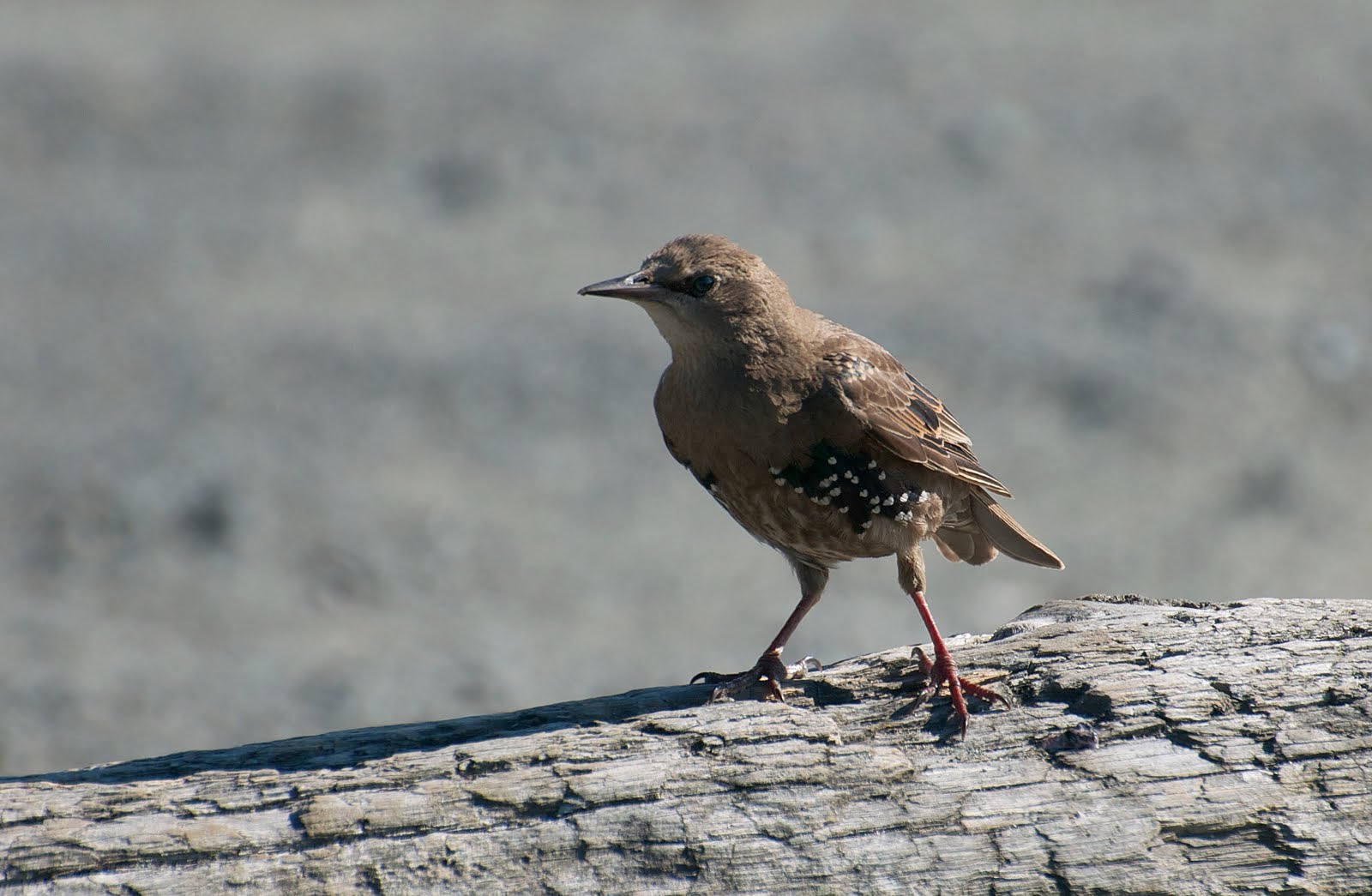
European Starling - Juvenile Molt

I'm getting a bit behind on posting. I've still got some images from weeks ago that I want to post. Reviewing all the pictures and post processing can take a lot of time, so sometimes I put up the "easier", "quicker" image to get a post up leaving some of the tougher (sometimes better images) images behind.
Such is the case with tonight's post. I only got a couple pictures of this juvenile European Starling, so it doesn't take long to decide which to post, work it up and upload. It's an interesting picture as the juvenile is beginning to molt into adult basic plumage, evidenced by the mostly brown coloring with the start of black, spotted, adult feathers emerging on its belly. But I have some great pictures of Semipalmated Plovers, Western Sandpipers, Sanderlings and Heermann's Gulls from a couple of weeks ago and some nice pictures of what I think are Semipalmated Sandpipers from this past week that I have been pondering. Sometimes quantity can be overwhelming. :-)

Sunday, August 28, 2011

Cooper's Hawk - Juvenile

My wife and I made two visits to Beacon Hill Park in Victoria, BC. It's really a beautiful park with a diversity of environments, from harbor coast to grasslands to dense forest to floral gardens to a petting zoo and a cricket field, all very well done.
While there were large numbers of birds, the diversity was low, I suspect due largely to the time of day and year. The most interesting bird was a juvenile Cooper's Hawk that I found near the top of low Willow tree we happened to be standing under. It stuck around just long enough to get a couple of shots.
Other than that, there were large numbers of Mallards, Canada Geese, Rock Pigeons and Crows.
To spice things up and challenge the colorful flowers, they added a couple of Peacocks.
I also saw this odd, dark Mallard. I suspect it is a Mallard x domestic duck hybrid, but I did not see any domestic ducks anywhere in the park or the city.

Friday, August 26, 2011

Brown-headed Cowbird - Juvenile

Yesterday evening I got out and did my first serious birding in the Victoria area. Based on web recommendations I decided to drive to Esquimalt Lagoon and Coburg Peninsula. There wasn't a large variety of birds, but there were a lot of birds; predominantly California Bulls, Canada Geese, Brewer's Blackbirds and Mute Swans.
The most interesting bird I found had to be the juvenile Brown-headed Cowbird, or at least I'm pretty sure that is what it is. There was an interesting discussion just last week on this bird as it is one of the birds most often misidentified. One of the reasons is that Brown-headed Cowbirds lay their eggs in the nests of other birds and let them raise the young. Therefore it is unusual to see a juvenile with its parents, making it hard to identify by association. In fact, I did not see any adult Brown-headed Cowbirds, the nearest birds to the juvenile were some Brewer's Blackbirds. See more info on this behavior at Cornell's All About Birds.
Also, see an interesting ID article on BirdFellow.

Monday, August 15, 2011

House Wren - Juvenile

Even during the dog days of summer, there always seems to be something interesting at RNWR.
Just after the first stretch of road on the auto tour after the left turn is a small grove of trees. There's been more activity there this summer than I am used to, so I have been taking my time driving past. In the past I've found Western Tanagers and Black-headed Grosbeaks.

This time I found a juvenile House Wren. I heard it first, then noticed the tall grass moving at the source of it's staccato chirp. Then, after following what I think was an adult House Wren work its way up a tree and out of sight, I looked up at a branch not far from my car window and there sat the juvenile.
It was quite content, occasionally chirping, usually single notes, but occasionally stringing a few together.
Then it grew quite and its eyes began to droop...
...until they closed tight.
But it wasn't long before they opened again and before I knew it, it flew off into the tree that I had seen the adult, eventually moving on out of sight.
Always something interesting at Ridgefield. Too bad it's such a long drive.

Friday, August 5, 2011

House Finch - Juvenile

I believe this is a juvenile House Finch. The beak and coloring looks right for a female or juvenile House Finch and the corner of the beak looks a little gummy. I found this bird at Fernhill Wetlands last Sunday near Dabbler's Marsh in the same area that I saw several other juveniles.

Tuesday, August 2, 2011

Willow Flycatcher - Juvenile

I made my first visit to the Sandy River Delta area this past Saturday. As with all new areas, I spent some time just learning the place. It was interesting as I was expecting a sunny day and it started out that way when I left home from Wilsonville, but as I started traveling east on I-84, it started getting cloudy and gloomy and stayed that way the whole time I was there.
As with most places now, there were a fair number of juveniles. I found a couple of juvenile Willow Flycatchers (along with juvenile Common Yellowthroats and Lazuli Buntings) in an active Blackberry patch. I have to thank members of the Portland Area Birds with their help in identifying the flycatcher as I don't see a lot of flycatchers for some reason and of course the Empidonax genus can be a challenge as they are very similar in appearance. Lack of eye ring, habit (they nest in bushes like Blackberries), and a browner coloration rather than greenish were reasons given for choosing a Willow Flycatcher.

Sunday, July 31, 2011

Common Yellowthroat - Juvenile

I spent the late morning and early afternoon at Fernhill Wetlands today. Birding was relatively slow for this hot spot, but there was still interesting things to see. I saw one of the three Clark's Grebes that had been common here this Spring and some shore birds are starting to show up now that the water levels are starting to lower leaving some nice mud flats.
The most numerous birds, though, wasn't a species, but an age. There were plenty of juveniles to be seen.
I found this juvenile Common Yellowthroat near Dabbler's Marsh. That area was probably the busiest, with juvenile Song Sparrows, American Robins, House Finches and Tree Swallows. Also a few I haven't figured out yet.

Tuesday, July 26, 2011

Pied-billed Grebe - Juvenile

Last Friday along the auto tour at RNWR, as I passed marker 12 at the beginning of the last canal, I was hopeful that I would find something interesting. It's not uncommon to see American Bitterns along this stretch, though the occurrences have tapered off with the coming of summer. No luck with Bitterns, but I did get some good looks at my first juvenile Pied-billed Grebe.
This Grebe was dining on minnows. It didn't completely dive under the water like an adult. Instead, it would point its head straight down as if looking deep into the water and then plunge its head in, many times successfully retrieving one of the small fish. I have never seen an adult stare down into the water like this juvenile did.

Thursday, July 14, 2011

Purple Finch? - Juvenile

On our way back home from Bandon over the 4th weekend, we stopped at Shore Acres State Park to walk through the wonderful garden they have there. Other than at my feeder, I got my first sighting of a Purple Finch. It was singing up a storm on a pine branch along the edge of the garden. It seems odd to me that while I see Purple Finches regularly at my feeder, I had not seen one in the field other up until then.
Tonight I saw a bird at my feeder that I wasn't quite sure of, so I grabbed my camera and took some pictures. It was pretty tolerant of me so I figured it was probably a juvenile and when I got a look at the pictures the gummy corners of its bill confirmed my suspicion.
So the next thing to consider was what species was it? My thought the whole time was a Purple Finch because of the frequency of adults I get (I actually get many more Purple Finches than House Finches). Though it has much less of an eyebrow than a similar looking female, I really think this is a juvenile Purple Finch. Let me know if you know otherwise, or if you know for sure!

Thursday, June 2, 2011

Song Sparrow - Early Fledgling

Travel, travel, travel. I'm getting tired of it. I've been on the road on business four of the last six weeks. On top of that, I've been fighting a cold for going on two weeks now. Oh well, could be worse, could be raining. Oops.
Last Sunday I stopped by Jackson Bottom Wetlands Preserve. I don't bird there as often since I've discovered Fernhill Wetlands. It was mid-afternoon and things were fairly slow as expected. Highlights include my first Ring-necked Pheasant photograph, though it was way off in the distance. It's been the only bird I have seen and positively identified and not photographed. I also saw a few Warbling Vireos. Last spring I saw one, this spring I've seen many in lots of various places. Not sure why.
Another interesting sighting was that of an early Song Sparrow fledgling. You can see the gummy corners of its bill in the images above. I saw some of these last year as well and they threw me for a while. This is quite a bit earlier than I noticed them last year.The next two images are adults. I took one of my favorite pictures of a Song Sparrow on this same wire last spring about this time.