 This male Common Yellowthroat spent a lot of last weekend singing away in this tree at RNWR.
Monday, April 30, 2012
Common Yellowthroat
This male Common Yellowthroat spent a lot of last weekend singing away in this tree at RNWR.

Dunlin

Fernhill Wetlands has had some high water lately, so I decided I'd try Jackson Bottom Wetlands Preserve this past Saturday in hopes of seeing some interesting shorebirds. I stopped by Jackson Bottom on my way home from Fernhill Wetlands last weekend and noticed that the restoration work on the Wapato Marsh Wetlands was complete. This appeared to be great shorebird habitat.
Things were a little slow as I approached, but soon I started seeing peeps (mostly Least Sandpipers from what I could tell) everywhere. The ponds also attacked scores of Barn Swallows.
Peeps were the only shorebirds I saw for awhile other than a few Killdeers. But eventually I spotted some Dunlins. Though not uncommon, I've only identified Dunlins once before a couple of years ago, again, here at Jackson Bottom.
Initially they spent some time in a shallow area in the middle of a pond, then got quite active, flying around the area, disappearing for awhile, then reappearing.
Things were a little slow as I approached, but soon I started seeing peeps (mostly Least Sandpipers from what I could tell) everywhere. The ponds also attacked scores of Barn Swallows.
Peeps were the only shorebirds I saw for awhile other than a few Killdeers. But eventually I spotted some Dunlins. Though not uncommon, I've only identified Dunlins once before a couple of years ago, again, here at Jackson Bottom.
Initially they spent some time in a shallow area in the middle of a pond, then got quite active, flying around the area, disappearing for awhile, then reappearing.

Then, as I was pursuing a Greater Yellowlegs and a Spotted Sandpiper, the flock of Dunlins landed on the shore right in front of me. Hoping this would happen all morning, I remember thinking to myself, "Ok, don't screw this up". No sooner did I lift my camera, than they all took off. The image above is the best I got as they flew off.

But, for whatever the reason, they began circling the marsh again, making passes nearby a few times. Being a typical gloomy spring day, the low light made it difficult to get sharp images of them in flight, however the one above turned out reasonably well. That big black spot on their bellies during breeding season makes them easy to identify and makes for a handsome bird.
Wednesday, April 18, 2012
Marsh Wren


This seems to be a good year for Marsh Wrens. Especially at RNWR. The area between markers 10 and 11 is thick with them. And since they are in fine Spring voice, they are much easier to find.
Tuesday, April 17, 2012
Wilson's Snipe


One of my favorite places to photograph birds is along South Quigley Lake at RNWR. You can drive right along the shore and see birds just outside your car. And not just your every day birds, but Soras and Virginia Rails, not to mention great close-up views of Red-winged Blackbirds and an occasional American Bittern.
The only downside of this area is the amount of grass, weeds and cattails you have to shoot around or through. But if you are patient, and take advantage of the spring before the vegetation gets out of control, you can usually get some pretty cool pics.
Today, as I drove along the waters edge, I saw a Wilson's Snipe for the first time. Snipe are common at Ridgefield, but I've never seen one at this location. It was great to finally get some real close views of one as they are usually seen off the road a bit.
The only downside of this area is the amount of grass, weeds and cattails you have to shoot around or through. But if you are patient, and take advantage of the spring before the vegetation gets out of control, you can usually get some pretty cool pics.
Today, as I drove along the waters edge, I saw a Wilson's Snipe for the first time. Snipe are common at Ridgefield, but I've never seen one at this location. It was great to finally get some real close views of one as they are usually seen off the road a bit.
Monday, April 16, 2012
Eurasian Collared-Dove


It's getting more and more common to see Eurasian Collared-Doves on the way to Fernhill Wetlands, usually fairly nearby. They are typically perched on a power line and appear a little larger and paler than Morning Doves. Interestingly, they seem to be quite tolerant of me stopping and taking their picture. Most birds will fly as soon as they see you pulling over to get a closer look, but these Doves usually sit there for quite a while without being spooked.
Sunday, April 15, 2012
Golden-crowned Sparrow


I spent some time looking for the reported Swamp Sparrow at Fernhill Wetlands on Saturday. No luck with that. I talked with a few bird(er)s who said they had seen it earlier in the morning, so I decided to try again. I even got my iPad out and played its call to see if I could coax it out. Still no luck. It's the first time I have every tried play bird calls to attract a bird.
Later, on the Dabblers Marsh Trail, I came upon a few Golden-crowned Sparrows in a small grove of trees. They weren't far from me but they stayed in among the cover of the branches, not giving me a clear view. So I decided I try my iPad on these sparrows. Much better luck, not only did it pull one out very near me, they also began to sing along with the iPad.
I tried the iPad again in an area where I regularly see Bewick's Wrens and it worked again, if only briefly.
Even with the success, I'm not sure I'll try this too often as it's usually frowned upon, especially with rarer birds, but it sure was fun. :-)
Later, on the Dabblers Marsh Trail, I came upon a few Golden-crowned Sparrows in a small grove of trees. They weren't far from me but they stayed in among the cover of the branches, not giving me a clear view. So I decided I try my iPad on these sparrows. Much better luck, not only did it pull one out very near me, they also began to sing along with the iPad.
I tried the iPad again in an area where I regularly see Bewick's Wrens and it worked again, if only briefly.
Even with the success, I'm not sure I'll try this too often as it's usually frowned upon, especially with rarer birds, but it sure was fun. :-)
Sunday, April 1, 2012
Say's Phoebe


This Say's Phoebe landed in my lap sort to speak. I was in my car taking pictures of a flock of American Pipits in a grassy field at Paramount Ranch in California when a bird landed on a post right next to me. To my delight it was a Say's Phoebe, the only one I saw the whole time I was in California last week.
Saturday, March 31, 2012
Royal Tern


After I completed my work in California a week ago Thursday, I decided to check out the coastline around Malibu before heading back to the Hotel. I happened to notice a pond on the beach and several gulls nearby so I decided to stop. It was called Zuma Beach and there turned out to be an interesting variety of waterfowl in the pond. I saw American Coots, Mallards, Northern Shovelers, Ruddy Ducks and Buffleheads. There were also some swallows flying over the pond. I believe they were Northern Rough-winged Swallows, but my pictures aren't very good as the sun was about to touch the ocean making for poor lighting conditions.
After seeing all I could at the pond I decided to check out the gulls. It appeared to be mostly Westerns with a few Ring-billed and Californias, but I was pleasantly surprised to find a single tern. It appears to me to be a young Royal Tern, probably transitioning out of juvenile plumage as it has a fair amount of black on its wings and tail and also has partially orange legs. It appears as though its legs are also transitioning as they are a mix of blotchy orange and black. It could be that it was wading in something that stuck to its legs, but since I see many signs of transitioning to an adult, I'll stick with the color transition theory.
After seeing all I could at the pond I decided to check out the gulls. It appeared to be mostly Westerns with a few Ring-billed and Californias, but I was pleasantly surprised to find a single tern. It appears to me to be a young Royal Tern, probably transitioning out of juvenile plumage as it has a fair amount of black on its wings and tail and also has partially orange legs. It appears as though its legs are also transitioning as they are a mix of blotchy orange and black. It could be that it was wading in something that stuck to its legs, but since I see many signs of transitioning to an adult, I'll stick with the color transition theory.
Friday, March 30, 2012
Black Phoebe

A Black Phoebe at Paramount Ranch in California played cat and mouse with me for a while until I finally got a close look from my car as I drove past a log fence.
Wednesday, March 28, 2012
Western Scrub Jay


This Western Scrub Jay was much more cooperative that most. I almost missed out on this opportunity as I was walking away from having photographed a Western Kingbird at Paramount Ranch when I decided to go back for some more. I didn't get any more Kingbird photos, but I did get some of my best of this Scrub Jay.
Tuesday, March 27, 2012
Brown Pelican


I was back in the LA area during the latter half of last week and was lucky enough to have stopped by a small coastal park named La Piedra Beach where I found a flock of Brown Pelicans. The parking area was high above the beach but had a narrow trail leading down to the water.
I took my time traversing the trail, eventually have to scale some rocks to get down to the beach. The pelicans were right in front of me so I moved very slowly, stopping for a bit then inching a little closer. I had to work my way to the right of them as it was late in the afternoon and the sun was of to the side.
Luckily, though a few stirred occasionally, I was able to get quite close getting my best pictures to date of these majestic birds. Another plus is that they were nearly all in breeding plumage. It seems I usually always see them in autumn in Oregon when they have lost most of their more vibrant colors.
Monday, March 19, 2012
Marsh Wren


The Marsh Wrens were out in full force on Friday at Ridgefield National Wildlife Refuge. There were several amongst the reeds along the road around marker 10. I also saw one Pacific Wren in the same area.
These wrens can be a challenge to shoot as they rarely sit still and tend to stick down low in the reeds. But in the spring they sing almost as much as they move, making it easier to find them, and, with a little patience, capture one in a moment of non-obstruction.
These wrens can be a challenge to shoot as they rarely sit still and tend to stick down low in the reeds. But in the spring they sing almost as much as they move, making it easier to find them, and, with a little patience, capture one in a moment of non-obstruction.
Thursday, March 15, 2012
Ring-billed Gull


 So, I've gotten very busy at work. Not just work load, but travel too. In addition, I've gotten a bit burned out with blogging. But, since I really enjoy the combination of birding, photography and blogging I don't want to give it up. I guess I just need to work through this busy time and not let the blogging slip away.
Last week I was in the small town of Leominster, MA overseeing the commissioning of a new lighting system in their high school. Since school was in session, we had to wait until classes were over for the day before we could start work. That gave me the opportunity to spend some time birding in the mornings.
I spent some of the time on both Tuesday and Thursday hiking around Mirror Lake in Coggshall Park in nearby Fitchburg. On Tuesday the lake was frozen over and birds were scarce, but by Thursday things had warmed up enough that most of the lake was melted and people were out enjoying the weather.
The birding wasn't much better, but there was a flock of Ring-billed Gulls on the lake. At one point, a family started throwing bread out to the gulls. I decided to take advantage of the situation and began shooting the gulls as they flew about the area.
 While the Ring-billeds at the top of this post are clearly adults and mostly in clear breeding plumage, the bird above appears to still be in non-breeding plumage.
 This bird appears to be a 1st winter based on the black band on its tail.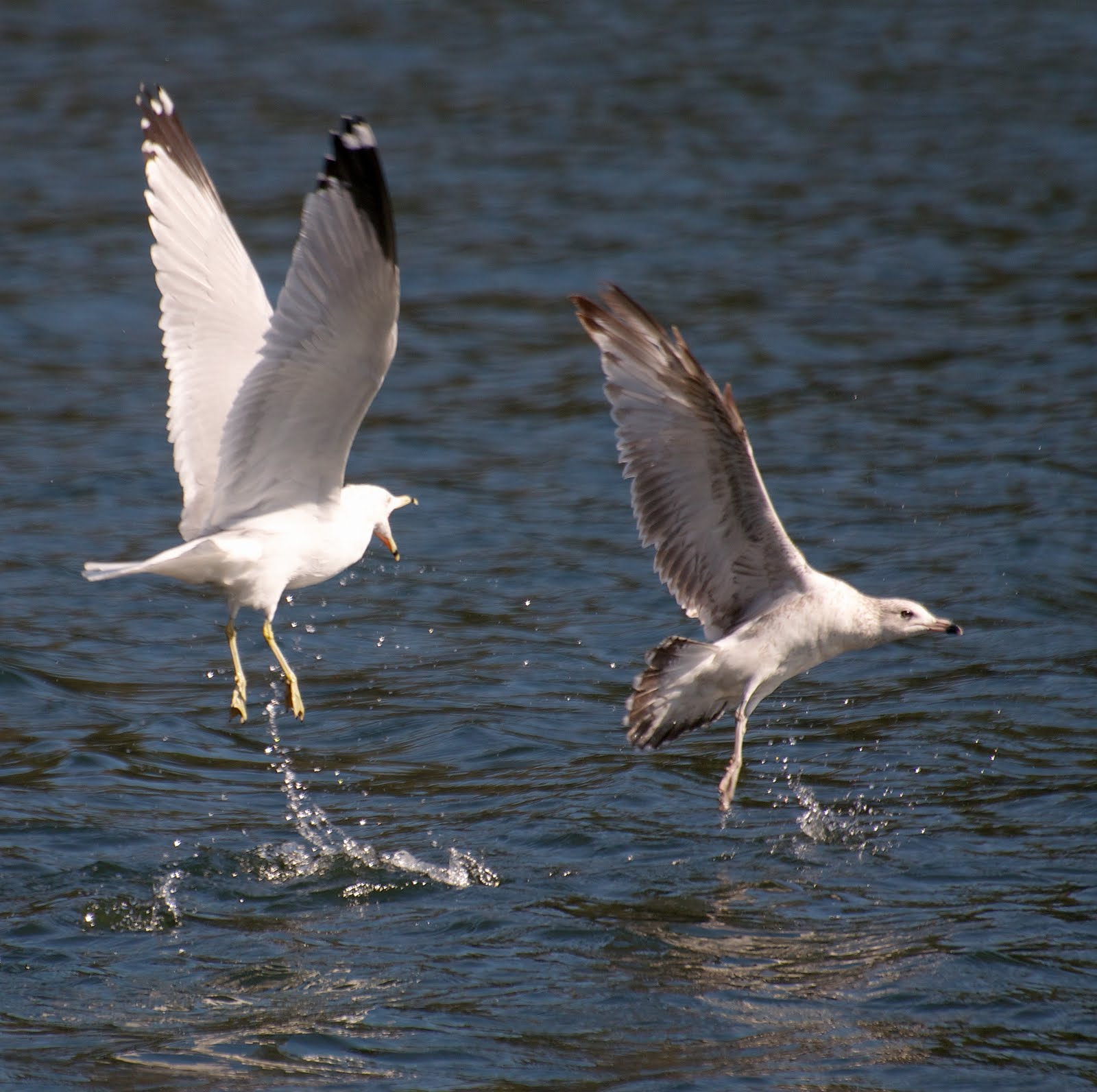
 At one point there was quite a commotion as, for some reason, an adult got quite upset at one of the juveniles. It chased and pecked at the youngster until they both finally settled back down on the water.
 Wednesday, February 29, 2012


Tuesday, February 21, 2012
Black-capped Chickadee
 When I first started birding almost two years ago, I spent most of my time near my home in Wilsonville. I didn't know about the all the hot spots in the area and the variety of birds that could be found. I discovered Tualatin River National Wildlife Refuge very early. It was only about a 15 minute drive from me and I saw a lot of birds there.
As I progressed, I began finding areas with more photography opportunities and more exotic birds. I grew a bit bored with TRNWR. Well, I had a little time on Sunday afternoon, so I decided to walk the trail to the observation deck. Along the way, as I passed through the Oak Savannah, I was surrounded by a flock of Western Bluebirds. Unfortunately, about that same time, several groups of people came walking through the area and the Bluebirds decided to move on.
A lone Chickadee stayed put however, and gave me one of my better opportunities to photograph this species in the wild (no feeder). It got me thinking a bit how the type of birds that I shoot has changed as my normal stooping grounds have evolved. I shoot less passeriformes now than I used to. Sunday afternoon was a nice change.
Saturday, February 18, 2012
Green-winged Teal - Eurasian Subspecies


 This Eurasian form of Green-winged Teal (also referred to as a Common Teal) was seen on Coffee Lake just outside of Wilsonville, OR. The two are very similar in appearance with the most obvious difference being the Eurasian's lack of a vertical white stripe in the shoulder area and the addition of a thin white horizontal line on its side which is missing on the American variety. The Eurasian also has a more pronounced and continuous creamy line that circles the front of its cheek, just behind the bill and around the eye.
While fairly rare in North America it is not unusual to hear reports of their sighting here in the winter.
While still considered the same species, the AOU is still debating whether to separate them.
Thursday, February 16, 2012
Common Goldeneye
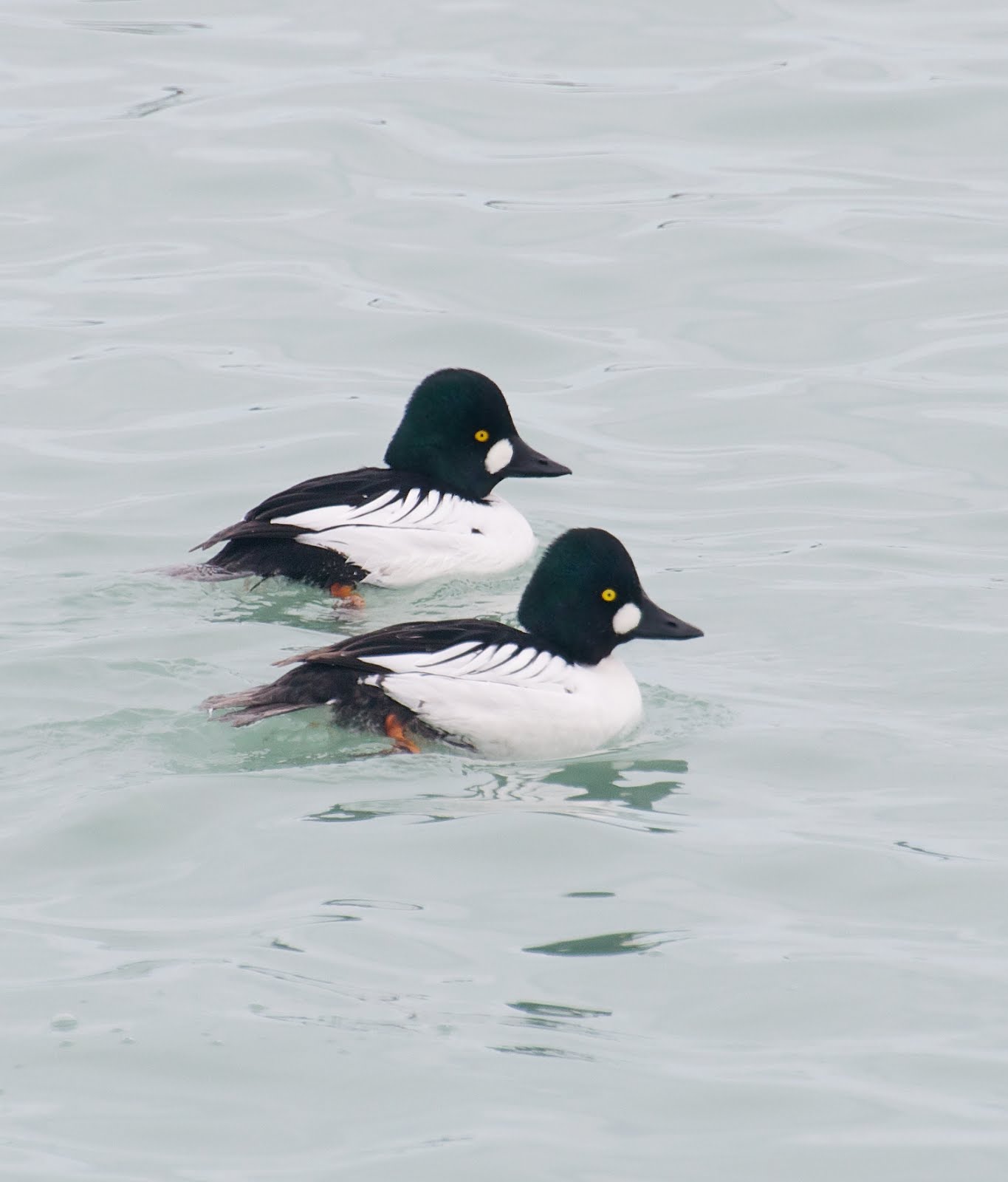

 I got my best views to date of Common Goldeneyes on Lake Michigan at the same location that I saw the American Black Ducks.
 Tuesday, February 14, 2012
American Black Duck
 I've seen pictures of Black Ducks in field guides and wondered how you could possibly be sure they weren't just female mallards. Well, it turns out that in real life, it isn't as hard as it might seem.
During the field trip I took with the Chicago Ornithological Society in January, we ventured out along a rocky periphery of some property belonging to a power company along Lake Michigan. It reminded me a bit of the jetties at the coast here in Oregon, but these giant boulders were squared up more making the trek less treacherous even though there was an inch or so of snow on them. None-the-less, one from the group slipped into a crack between a couple of the rocks, loosing her boot and hurting her foot enough that see decided to sit this one out. Luckily our leader was able to reach down into the crack and retrieve her boot.
Our destination was a patch of open water, the ice melted by a flow of water from the plant. As we approached, one from the group mentioned to me that we would probably see some Black Ducks, realizing that I had probably not seen any, being from the West. I asked if it would be hard to pick them out from the female mallards. He said, "If you not sure, they aren't Black Ducks". He was right, they are definitely darker than female Mallards and it is easy to pick them out. In the image above, the Black Duck is on the right just above the male Mallard.  Here a Black Duck leads a couple of female Mallards. While the body is obviously darker, the color of the feathers are also more uniformly colored. Another obvious difference is the bill. The male Black Duck has a clear, yellow bill with a black tip, just like a male Mallard, not the orange bill with black spotting of a female Mallard. Supposedly a female has a greenish gray bill with spotting, but all that I saw seemed to have yellow bills.
 Here a Black Duck leads a couple of female Mallards. While the body is obviously darker, the color of the feathers are also more uniformly colored. Another obvious difference is the bill. The male Black Duck has a clear, yellow bill with a black tip, just like a male Mallard, not the orange bill with black spotting of a female Mallard. Supposedly a female has a greenish gray bill with spotting, but all that I saw seemed to have yellow bills.
 One of things I thought interesting was the fact that the birders in Chicago make it a common practice to throw bread out on the water to bring in the ducks and gulls. I'm not talking a few slices, I'm talking loaves. It seems this would be against birding ethics and I've heard that bread isn't good nutrition for birds, but it seems bird ethics are a bit like pirate laws, they're more like guidelines. :-)
 Finally, this last image shows an American Black Duck cross with a Mallard. Notice the green on side of the head of the second bird from the left.
Subscribe to:
Posts (Atom)