Showing posts with label Canada. Show all posts

Friday, September 2, 2011

Northwestern Crow?

There were a lot of Crows in Victoria, especially in Beacon Hill Park. Questions is, what kind of Crow? Based on range, they should be Northwestern Crows, though they are mostly indistinguishable from American Cows. Supposedly slightly smaller and slightly deeper call, I am not experienced enough to know for sure. Most range maps show the Northwestern Crow's range to start in the upper left hand corner of Washington state and extends north along the coast of Canada well into the southern coast of Alaska, while the American Crow's range is excluded from this area.
So I suppose they are Northwestern Crows, though some dispute that they actually a separate species. There was a rather spirited discussion on this topic a few months ago on OBOL.
The top two images are of a juvenile, while the bottom is an adult.

Wednesday, August 31, 2011

Semipalmated Sandpiper

I've been staring at these pictures for some time since I took them last Friday at Coburg Peninsula during our trip to Victoria. I've been trying to convince myself that the bird is a Semipalmated Sandpiper and not a Western Sandpiper, but I am not very experienced with Western Sandpipers and have never identified a Semipalimated Sandpiper.
They have been commonly reported on OBOL recently so I have been hoping to see one. Trouble is, they look almost identical to Western Sandpipers. The biggest difference is the bill. Westerns have a longer bill that droops down a little at the tip. Semipalmated's bill is shorter and not as drooped. Semis also have a grayer, less rufous back than Westerns, but with the variations of coloring within each species, they kind of blend together.
It took quite some time before I started getting more confident on the identification. Then I got the idea to try a Yellowlegs identification technique and compared the length of the bill to the length of the head. Sure enough, the bill on this bird is clearly proportionally shorter than its head compared to the bill/head proportion of Western Sandpipers. So, I'm now about 99% sure of the ID.
I found three of these Sandpipers together on the harbor side of Coburg Peninsula. They were on a small mudflat and had enough trust to let me get in close. As a matter fact, the top picture is of one walking right past me as I was kneeling on the beach. All three scooted right past me. I practically screwed myself into the sand as I followed them with my camera. :-)

Tuesday, August 30, 2011

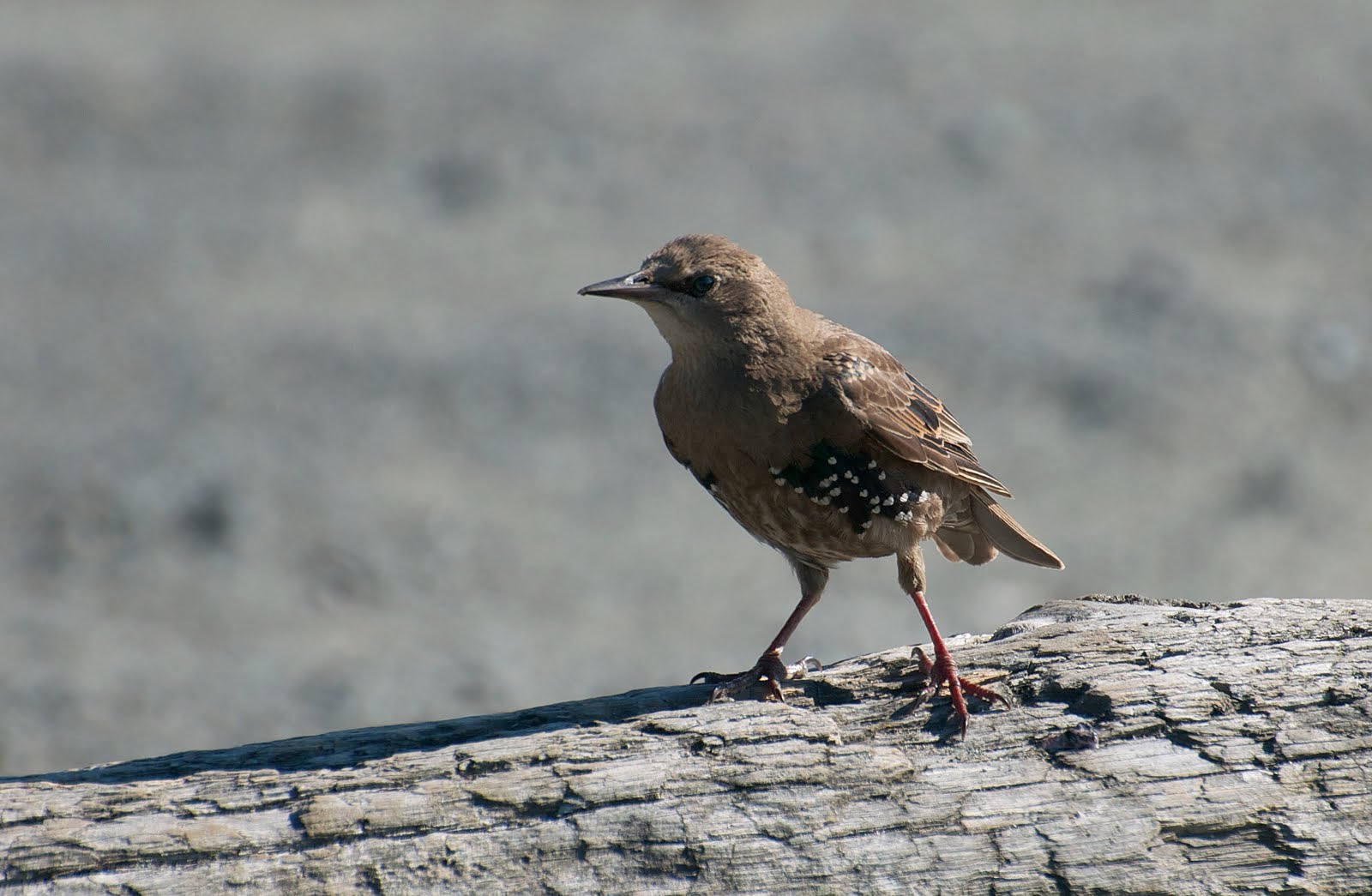
European Starling - Juvenile Molt

I'm getting a bit behind on posting. I've still got some images from weeks ago that I want to post. Reviewing all the pictures and post processing can take a lot of time, so sometimes I put up the "easier", "quicker" image to get a post up leaving some of the tougher (sometimes better images) images behind.
Such is the case with tonight's post. I only got a couple pictures of this juvenile European Starling, so it doesn't take long to decide which to post, work it up and upload. It's an interesting picture as the juvenile is beginning to molt into adult basic plumage, evidenced by the mostly brown coloring with the start of black, spotted, adult feathers emerging on its belly. But I have some great pictures of Semipalmated Plovers, Western Sandpipers, Sanderlings and Heermann's Gulls from a couple of weeks ago and some nice pictures of what I think are Semipalmated Sandpipers from this past week that I have been pondering. Sometimes quantity can be overwhelming. :-)

Sunday, August 28, 2011

Cooper's Hawk - Juvenile

My wife and I made two visits to Beacon Hill Park in Victoria, BC. It's really a beautiful park with a diversity of environments, from harbor coast to grasslands to dense forest to floral gardens to a petting zoo and a cricket field, all very well done.
While there were large numbers of birds, the diversity was low, I suspect due largely to the time of day and year. The most interesting bird was a juvenile Cooper's Hawk that I found near the top of low Willow tree we happened to be standing under. It stuck around just long enough to get a couple of shots.
Other than that, there were large numbers of Mallards, Canada Geese, Rock Pigeons and Crows.
To spice things up and challenge the colorful flowers, they added a couple of Peacocks.
I also saw this odd, dark Mallard. I suspect it is a Mallard x domestic duck hybrid, but I did not see any domestic ducks anywhere in the park or the city.

Saturday, August 27, 2011

Rock Pigeon

I saw many more Rock Pigeons in non-urban areas in the Victoria area. Even Coburg Peninsula was full of them.

Friday, August 26, 2011

Brown-headed Cowbird - Juvenile

Yesterday evening I got out and did my first serious birding in the Victoria area. Based on web recommendations I decided to drive to Esquimalt Lagoon and Coburg Peninsula. There wasn't a large variety of birds, but there were a lot of birds; predominantly California Bulls, Canada Geese, Brewer's Blackbirds and Mute Swans.
The most interesting bird I found had to be the juvenile Brown-headed Cowbird, or at least I'm pretty sure that is what it is. There was an interesting discussion just last week on this bird as it is one of the birds most often misidentified. One of the reasons is that Brown-headed Cowbirds lay their eggs in the nests of other birds and let them raise the young. Therefore it is unusual to see a juvenile with its parents, making it hard to identify by association. In fact, I did not see any adult Brown-headed Cowbirds, the nearest birds to the juvenile were some Brewer's Blackbirds. See more info on this behavior at Cornell's All About Birds.
Also, see an interesting ID article on BirdFellow.

Wednesday, August 24, 2011

Glaucous-winged Gull - Juvenile

I haven't taken any time to bird yet here in Victoria, BC, but I have taken a few pictures of birds. Based on plumage and beak color and the fact that Glaucous-winged Gulls are by far the predominant Gull here, I assume this is a juvenile Glaucous-winged Gull. It, along with another, were standing on the waters edge along a city walkway.

Thursday, June 30, 2011

Yellow Warbler - Fledgling Feeding

I was hoping that being out east in early summer would give me an opportunity to see a lot of cool warblers. Well, I saw a lot of warblers alright, but most all of them were Yellow Warblers. Le parc national des Îles-de-Boucherville was loaded with them.
Even with the high numbers, it was still difficult to get good pictures as these warblers are typical small birds, constantly moving and never letting you get very close. Just when you think you have a great shot, the bird will fly away just as you push the shutter. It can get frustrating.Then, as I was walking along a trail with tall grasses on either side, I came across a male and female that were feeding along the tops of the grasses near the trail. I was able to get many pictures, some of which turned out pretty good, even with the gloom of the overcast skies.Then, yet another surprise. I saw another Yellow Warbler that looked a little different and was flapping its wings vigorously as it was perched on a stalk. Soon another Yellow Warbler approached and I realized that the first warbler was a fledgling as the adult brought an insect and feed its young.I love watching adults feed their young.

Tuesday, June 28, 2011

Montreal Mammals

While I didn't see a lot of birds at Mount Royal Park in Montreal, I did see more mammals than normal. It started with Eastern Gray Squirrels. They were everywhere throughout the park and were rather tame.
Shortly after my first squirrel sightings, I noticed something moving high in the tree up ahead. It turned out to be a Raccoon sitting in a hole which may have been its den.
The rabbit below was huddled under some low hanging branches. Though it seemed a bit nervous, it didn't run off as I approached. I haven't been able to figure out what species it is, however I have a suspicion that it may be an escaped domestic rabbit.
There were a lot more birds than mammals at Le parc national des Îles-de-Boucherville which suited me just fine, but I a few great looks at mammals there too, starting with this White-tailed deer. It was munching on some grass along the trail and just stared at me for a couple of minutes while I photographed it before sauntering off.
After seeing so many Nutrias in the Portland area, it was nice to see a native large rodent. I believe this is a woodchuck.
Finally, as my day was coming to an end, I came upon a skunk and its babies. I followed them as they were making there way to the tall grass. Before entering, however, the parent turned and stared at me, beginning to move my direction. I quickly decided it was time for me to back off. :-)
Quite a few mammals on this trip made for some fun variety.

Monday, June 27, 2011

European Starling

These two wet European Starlings greeted me as I pulled into the parking lot at Le parc national des Îles-de-Boucherville on Saturday.
I have now seen European Starlings on 2 different continents, 3 countries and 6 states. I'm not sure that is a good thing. :-)

Sunday, June 26, 2011

Eastern Kingbird

As I drove the entrance road to Le parc national des Îles-de-Boucherville yesterday, this Eastern Kingbird was flycatching from some recently planted trees between the lanes. I was the only one around at the time, so I slowed down and inched up to it in my car in similar fashion to the auto tour at RNWR. I several good looks at it before it would fly on to the next tree.
It was a cloudy, rainy day which actually worked in my favor on this siting. The Eastern Kingbird has a red stripe on its crest that is typically hidden, however the rain matted its feathers down enough to make it easily visible.
New life bird number 3!

Saturday, June 25, 2011

American Redstart

I had the morning off today, so I visited Le parc national des Îles-de-Boucherville. Its an island in the St. Lawrence River similar to Sauvie Island in Portland except that just about the whole island is a national park and accessible to the public. It's really quite beautiful and is loaded with birds. There are a mix of trails ranging from graveled service roads to well-groomed grass trails like the one in the image above which I found to have the best birding.Early in the morning, one of the first birds I saw was an American Redstart. The male in the image above didn't stick around too long, but I was able to get this one reasonable shot. It's red flashes of red-orange where hard to miss and I knew almost instantly what I had seen.
New life bird number two!