 A Northern Harrier on the hunt yesterday at RNWR.
Saturday, March 12, 2011

Thursday, March 10, 2011
Northern Mockingbird


 A Northern Mockingbird seen at Corn Creek in Desert National Wildlife Range back on Jan 29.
Wednesday, March 9, 2011
Black-tailed Deer


 Just before I ran into the rash of Fox Sparrows and Hermit Thrushes on Bayocean Spit a week ago Saturday, I came across this Black-tailed Deer. It was just standing there staring it at me. Finally, after 30 seconds or so, it turned and slowly walked off into the thicket behind it. As I moved in a little closer I could see that there were actually two more Deer further back.
Monday, March 7, 2011
Great Blue Heron - Poised to Strike
 This Great Blue Heron held this pose the whole time I was taking pictures of the banded Canada Geese. I expected it to pluck a rodent off the ground at some point, but after 15 minutes I gave up and moved on. :-)
Sunday, March 6, 2011
Canada Goose - Neck Bands

 This past Friday I saw these Canada Geese with bright red neck collars at RNWR. I have gotten pretty good (I think) at separating out the Canada from the Cackling Geese, but I haven't really tried to determine the subspecies of each of these species. These Canada Geese, however, seem to be good candidates for a Dusky Canada Goose subspecies based on their dark breasts (notice the difference in breast coloration of the lead bird on the left in the top image with the rest).
One of the great things about finding birds with bands, in addition to finding out some of its history, is that you can find out its subspecies if one exists. So I have submitted these neck band codes to the USGS and will find out if my ID is correct. I was able to make out seven band codes by searching through the 62 images I took of the birds.
I had another experience with neck collars this past December when I came across some banded Tundra Swans, again at RNWR. I submitted three codes and received certificates with the banding information in about a week.


 As you can see, two of the Swans were banded by Ms. Susan Savage on 7/20/2009 in Alaska, while the other was banded by Ms. Kristine M. Sowl on 7/26/2007 in a different part of Alaska. The thing that jumped out at me when I received these certificates, was that the Swans were identified as Whistling Swans. At the time, Tundra Swans were new to me and I was trying to pick out a Trumpeter Swan amongst all the Tundras. I didn't realize that Tundra Swans are composed of two subspecies; the Whistling Swan and the Bewick's Swan. Bewick's typically can be identified by a large amount of yellow on the upper part of their bill, but there are variances that can make positive identification tricky.
Saturday, March 5, 2011
Red-winged Blackbird

 I made a trip around the auto tour at RNWR yesterday. Around marker 3, I came upon a couple of immature male Red-winged Blackbirds sitting in the cattails right along side the road. I saw a couple of similar immature Red-wingeds last year around this time.
The yellowish edges of the black feathers of an immature male adds an interesting feature to their plumage that I like. I've seen images of immature males on the internet with yellowish shoulder coloring. These male's wing patches are fully red except for a little yellow mixed in that you can see in the image below.
 I've noticed that while we've had Red-winged Blackbirds here most all of the Winter, they are starting to sing again like other birds have. It's great to hear that unmistakable song the male sings during the breeding season.
Friday, March 4, 2011
Chestnut-backed Chickadee


 I was able to get some close looks of this Chestnut-backed Chickadee as it was feeding on pine nuts at Bayocean Spit. There were a few of these Chickadees in the area and, like the Fox Sparrows and Hermit Thrushes, were unusually tame.
Thursday, March 3, 2011
Pacific Wren

 Winter Wrens like to hang low in the brush making it hard to see them and this one was no different. The difference in this case, however, was the brush. What is normally some type of foliage, was instead a pile of logs and large sticks. This left the Wren exposed for longer periods of time than is normal. The pile of wood was located below me as the trail rose up a bank with the beach below, so I was actually looking down on the Wren.
Wednesday, March 2, 2011
Fox Sparrow


 As I mentioned yesterday, I saw more Fox Sparrows this past Saturday on Bayocean Spit than I have in my whole life. What was so interesting is how tolerant they were of me. At one point, while kneeling, with them just a few feet in front of me, my memory card filled up, yet they didn't even flinch while I changed out the card.
It was really fun to watch them scratch away at the leaves and debre looking for things to eat.
They would spend a fair amount of time working on one spot, then quickly move to another.
Tuesday, March 1, 2011
Hermit Thrush

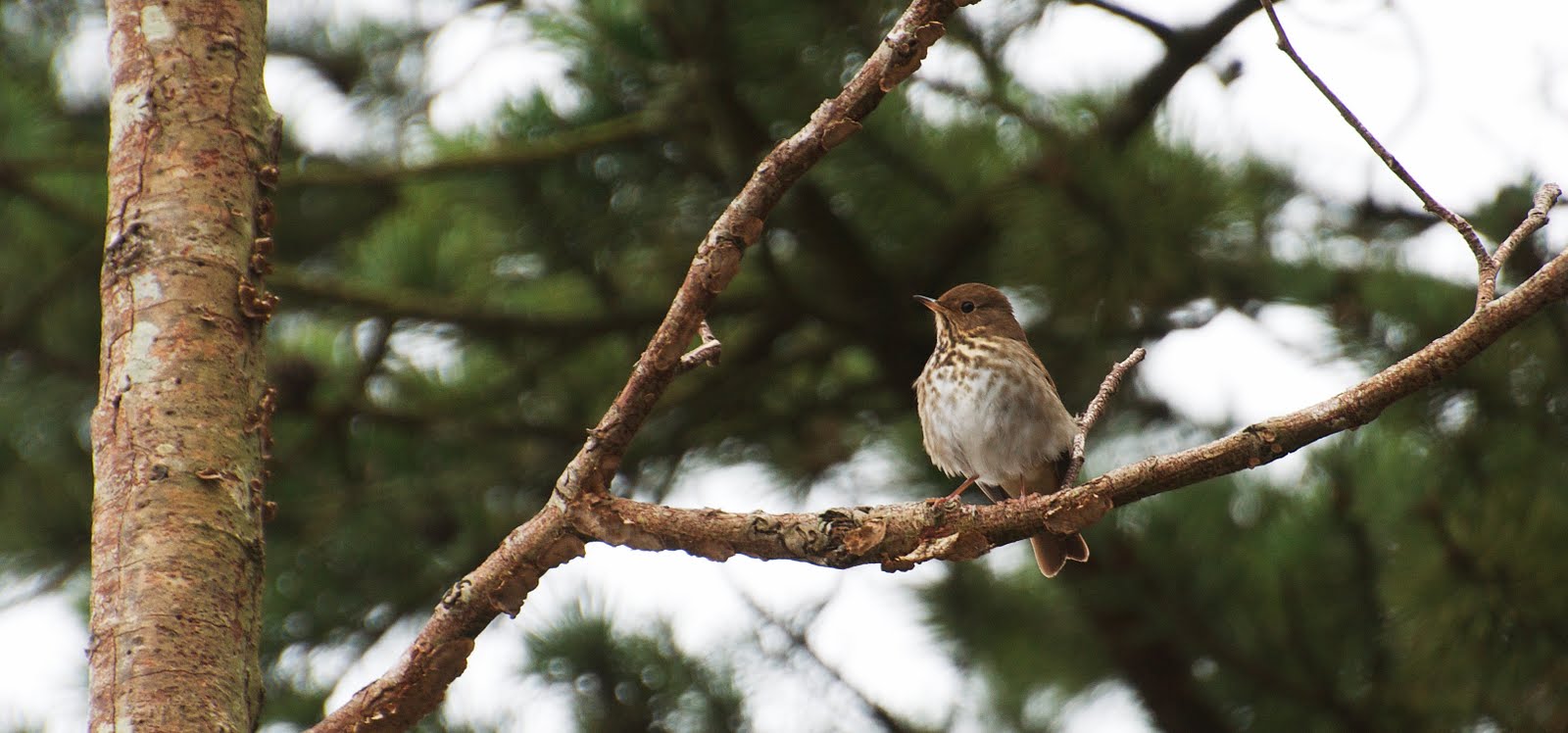 While the beach side of Bayocean spit was slow, the Tillamook Bay side was pretty active. Along with the first winter Glaucous Gull and Red-necked Loons I've already posted, I saw Surf and White-winged Scoters, Horned and Western Grebes, Common Goldeneyes, Bald Eagles and an usually high number of Fox Sparrows and Hermit Thrushes.
The Fox Sparrows and Hermit Thrushes started once the trail veered off the shore line and into the woods. I first saw four Fox Sparrows just off the trail scratching tirelessly through the dead leaves looking for food. While I was shooting the Fox Sparrows, the first of a series of Hermit Thrushes appeared, teasing me by only sitting still long enough to get a quick look, but not long enough to get a shot off.
Then I noticed another Thrush just up the path. This one was a little more cooperative, letting me get a few shots. It was pushing mid afternoon by then and the clouds were getting heavier and the light dimmer, but I did manage to get a couple of shots that were good enough to post.
While I don't know much about the singing of the Hermit Thrush, I found them similar to Song Sparrows in that all I heard them vocalize was a faint chirp. Nothing compared to the amazing songs they sing during the breeding season.
Monday, February 28, 2011
Red-throated Loon


 I saw two new species on Saturday at Bayocean Spit; the Glaucous Gull posted earlier and these Red-throated Loons. At least I'm pretty sure they are Red-throated Loons. There is a fair amount of variation in the neck coloring, but the cleanest of the birds fit well for a non-breeding Red-throated.
I believe the smudgier necked birds are juvenile as Sibley has illustrated them with more dark gray coloring.
If you look closely at the second bird from the right in the lower image, you will see that it has some reddish feathers on its lower neck. I wonder if these could be breeding color feathers?
Wilson's Snipe


 Just past marker 5, I believe, there is some shallow water in a grassy field at RNWR. I've seen Wilson's Snipe here a few times, but the are usually quite a ways off the road and blend in well with the surrounding vegetation.
On Friday, this area was thick with Snipe and they were near the road. In fact, as I drove up, I flushed a couple of small flocks. I decided to sit in my car for a bit and see if any returned. Sure enough, a few started making their way back near the road, allowing me to get my best pictures of them yet.
They still blend in well with the grass. :-)
Sanderling
 I walked around Bayocean Spit near Tillamook on Saturday. It's quite a walk, about four miles each way. I walked the ocean beach side first. There weren't very many birds on the beach that morning, but I did get some great looks at some Sanderlings.
I saw two flocks fly by and one of them decided to land just in front of me. It's great fun to watch them scurry along the waters edge looking for small invertebrates. They follow the surf out and then come running back as it comes back in. I used this to my advantage, positioning myself near where they would end up as the water came in and kneeled down low to be less ominous. Sure enough, they came in very close to me.
Shortly after a Western Gull swooped in and landed not far from the action with a crab in its bill.
 One of the Sanderlings took interest and started to move in.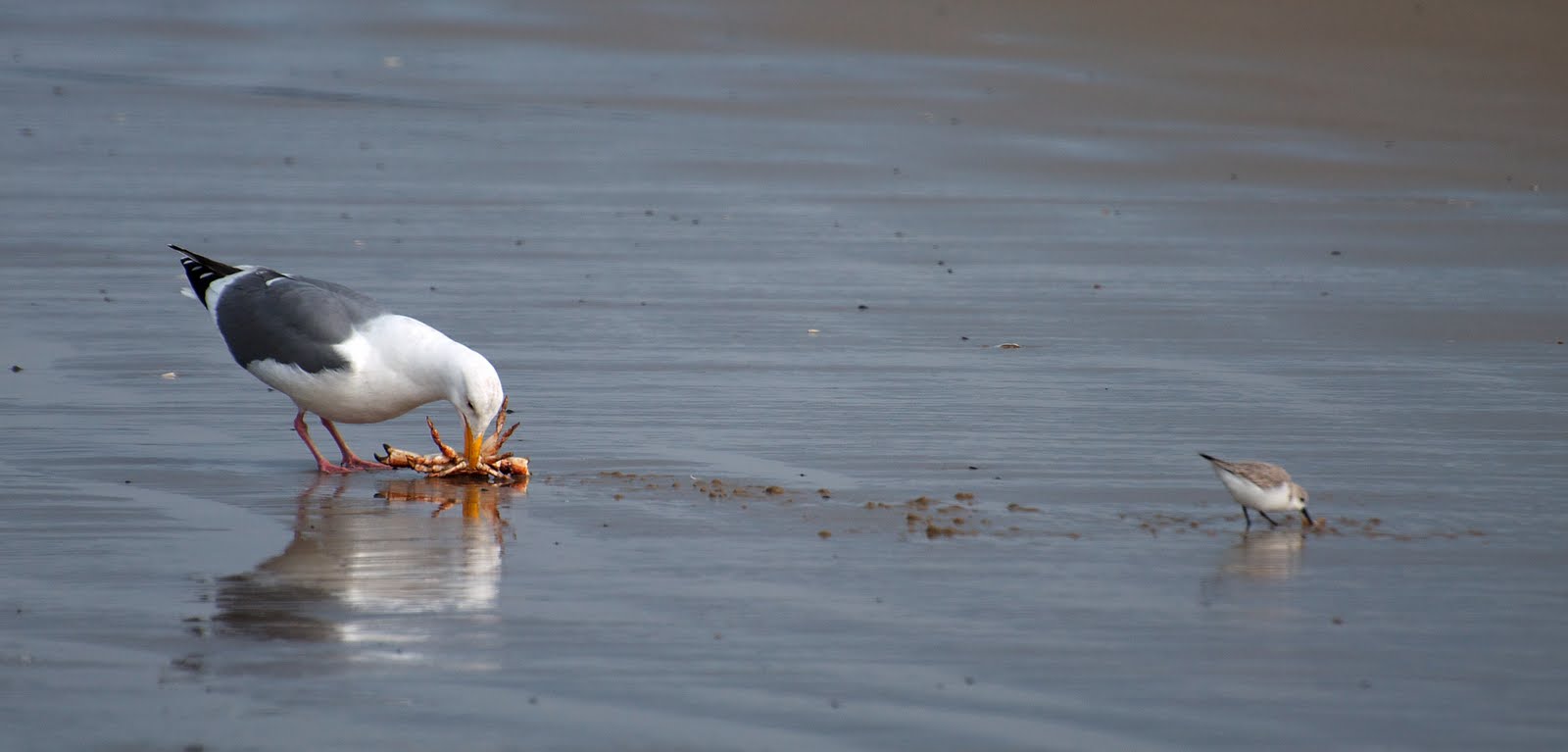
 I inadvertently helped it out as I moved in by spooking the Western.
 This gave the Sanderling its opportunity. While it showed interest and picked at the crab a little, it didn't start feasting.
 Feeling bad for the Gull, I backed off and it eventually returned to the crab.
Sunday, February 27, 2011
Northern Shrike
 I finally saw my first Northern Shrike. I took advantage of the sunshine on Friday afternoon and made a quick trip around the auto tour at RNWR. On the home stretch, I saw a bird fly in front of my car and land in the blackberry bushes to the right. I tried to position my car so that I could get a picture, but it flew off on the opposite side of the berm that runs along the road.
I took a chance that it might come back and drove up to the place it disappeared and waited. Sure enough, it flew up to the top of some branches of a bush. I was able to get a few decent shots of it before it flew off into the grassy area to the left and landed close enough to keep an eye on it.
 I watched for a couple of minutes until it suddenly reached down and plucked a rodent up from the ground.
 It only held on to it for a moment before it dropped it again and stood there as the rodent kicked. This lasted for what seemed like about a half a minute. I not sure, but it seemed like it was waiting for the rodent to die.
 It then scooped up the rodent and flew off.

Saturday, February 26, 2011
Glaucous Gull - Paler 1st Winter


 I thought I'd try to beat the cold today by going to the coast. :-) It's usually the other way around, but it was going to be very cold here today and the forecast indicated that the coast would be a little warmer. It was also supposed to be sunny. I'm not so sure it was much warmer, and it was hardly sunny, but I was well prepared for the cold and the wind was light.
I decided to go to Bayocean Spit and it turned out to be a pretty good day. For one, I saw my first Glaucous Gull. It threw me though as it turned out to be a paler 1st Winter juvenile. I expected a Glaucous to look a lot like a Western with a paler gray back and white wing tips. But, this one was practically all white except for a small amount of very pale brown speckles that I really didn't notice until it flew.
Besides the almost all white color, the other indication of a 1st Winter bird is the fact that it has a very dark eye.
Subscribe to:
Posts (Atom)