Thursday, August 5, 2010

Common Loon

As I mentioned back on July 27th, one of the birds I have fond memories of as a youngster, is the Common Loon. Not only do they look cool, they have the most eerie call.
While Lake Itasca in Minnesota is is great place to see and hear Common Loons, I got my best views of one at Lake Carlos State Park. It spent some time floating around just off shore a bit. Close enough to get OK shots, but not close enough to get great shots.
While watching the bird, I noticed that it occasionally lifted its head up pointing its bill into the air. The top image shows it with its head tipped the highest that I observed with its bill almost pointing straight up. While I didn't find many discussions of this behavior, apparently they do this when they are curious or on alert.

Tuesday, August 3, 2010

Mallard

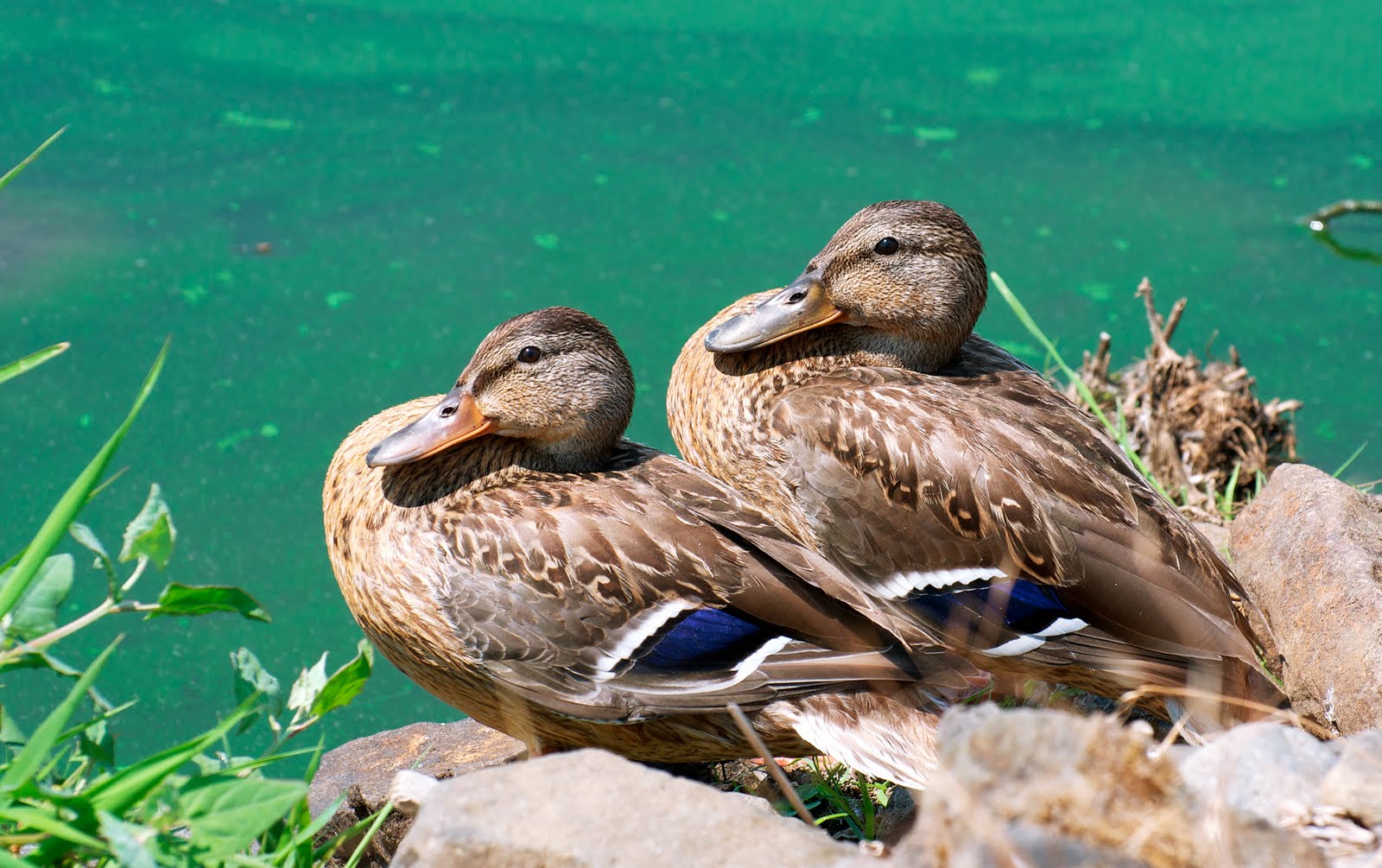
As the Summer progresses, I continue to see Mallards with their ducklings swimming in ponds around the area. For a while now, I've been noticing that its always the female parent that is with the ducklings. It seemed a bit strange to me, but I didn't give it much thought. However, as the weeks go by I began to realize that not only are there no males with the ducklings, there aren't any males period. Where have they gone?
The picture above was taken at Fernhill Wetland on Sunday where again I saw plenty of Mallards, but no males. So it was time to figure out what was going on. It turns out that the after breeding, the males molt and are left with coloring very close to the female. Its called their Eclipse Plumage. So, the males haven't disappeared, they are just incognito.
Based on my reading, the males should still have a clear yellow bill, so I assume the two in the image above are both female since their bill coloring is that of a female. But I will be on the lookout from now on for female looking Mallards will yellow bills. Hopefully I will see some and my missing male Mallard mystery will be solved.

Monday, August 2, 2010

Black-chinned Hummingbird

Back in late June during my first visit to the Rio Grande Nature Center State Park in Albuquerque, I came across a large cement wall with holes like small windows in it next to the visitor center. As I approached the wall I could see that there was a pond on the other side and that this was a blind of sorts for viewing the wildlife on the other side. There were quite a few birds and animals in the pond and surrounding area including Wood Ducks, Canada Geese, White-breasted Nuthatches, Squirrels, Red-eared Sliders and multitudes of Black-chinned Hummingbirds seen in the images above.
I wish the feeder would have been a little closer, but even so I was able to get some interesting pictures.
These Hummingbirds were in a feeding frenzy. They would dart up to the feeder, drink some sugar water and then fly off again. They made the most interesting sound as they flew by. It reminded me of the space ship that George Jetson flew to work. :-)
I have never seen so many Hummingbirds at one time.

Sunday, August 1, 2010

Great Blue Heron - Fishing

Sometimes it just pays to be lucky. You can plan all you want, but if the birds aren't cooperating, you aren't going to get many good pictures.
I was walking along the main pond at Fernhill Wetland when I saw a head sticking up above the grass along the shore. It was a Great Blue Heron and it was right in front of me. I expected it to fly off before I could get my camera up to my eye, but to my surprise it just stood there. It even let me move in closer, getting images that filled my view finder. (None of the images above were cropped)
I took several pictures as it stood almost motionless. I couldn't figure out why it wasn't flying off as Great Blue, never stick around when they see people.
Then, very quickly, it plunged its head under water and pulled out a fish. It was at that point that it flew off. I took pictures as fast as I could and got a few that captured the action. Makes me wonder if it just tolerated my presence the whole time because it had a bead on that fish.
Note how green the water is with algae.

Saturday, July 31, 2010

Great Egret

There were birds at my sisters that I didn't even know were in Minnesota as a kid. This Great Egret is an example. When I started seeing these here in Oregon I was trilled as I had never seen them before. Years later I return to Minnesota and find the flying around my sister's yard on a regular basis.

Eastern Phoebe

Another image from my sister's yard. They had quite a variety of birds. I saw several of these flycatchers. I have a terrible time identifying flycatchers as do many people, but I am fairly these were Eastern Phoebes. I based that on both its physical characteristics and the likelihood of there being in the region.
They were frustrating to photograph as they would never let me get very close and they usually had their back to me.

American Robin

As I mentioned a few days ago, there have been a lot of immature birds this spring and summer. Some can be a challenge to identify while other are obvious.
This immature American Robin was taken at my sister's homestead. Since Robins are so common, I've seen them in there immature state all my life so they are quite easy to recognize. Also, other than their spotted breast, they look a lot like a mature Robin.
This one was first sitting on a high-line wire along the road running past their property. It then flew across the road, into their yard and landed at the top of some dead branches.

Thursday, July 29, 2010

Red-eyed Vireo

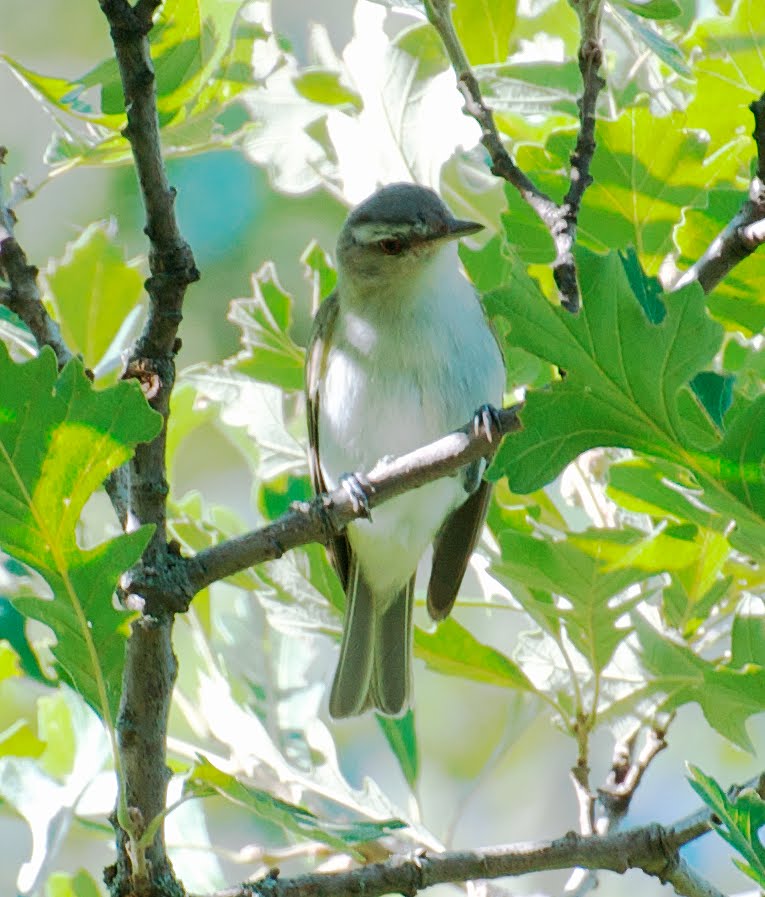
When I saw this bird while walking a path along Lake Carlos at Lake Carlos State Park in Minnesota, the first thing I thought was, it's a Red-eyed Vireo. I had never seen one before, but for some reason it has stuck in my mind since I was a kid.
When I first looked at the pictures on my computer I wasn't as sure, but tonight when I looked closer and lightened the image (the Vireo was in shadow and underexposed) its red eye revealed itself. That, along with the other characteristics all indicated a Red-eyed Vireo.
So, I have another new lifetime sighting!

Wednesday, July 28, 2010

Bushtit

Late Spring and early Summer has been interesting as there are a lot of young, immature birds. Many times they look different than fully mature birds I commonly see. For example, I took some pictures of a bird I was nearly convinced was a Orange-crowned Warbler until I realized that they were immature Common Yellowthroats.
The bird above did not fool me however as this immature Bushtit looks very much like a fully mature bird. I saw it a tree that was full of Bushtits. This one and another near it were behaving differently as they were quite sleepy and not flighty at all. The clincher for me though was the soft, yellowish corners of its beak. This is the remnants of the softer beak of a nesting bird.

Tuesday, July 27, 2010

Wood Duck

One of my birth families favorite parks to camp was Itasca State Park. During my stay with my sister and her family, we took a day trip to the park. One of the highlights of the park is Itasca Lake which serves as the source of the Mississippi River. I would imagine millions of people have had their picture taken walking across the stepping stones at the point along the lake shore where a small stream starts its thousand plus mile trip to empty into the Gulf of Mexico.
I have fond memories of camping there and hearing the eerie call of the Common Loon at night on the lake. While I only got one sighting of a distant Loon, I saw a few broods of Wood Ducks such as the one above near the shore.

Blue Jay

One of the birds I was hoping to photograph during my trip to Minnesota was a Blue Jay. I remember these striking birds as being quite common as a boy. Here in Oregon, Steller's and Scrub Jays are common, but we have no Blue Jays.
While I would have liked better ones, I did manage to get some pictures of a Blue Jay in the yard of my sister and her husband's homestead. It was perched in the shadows of a large tree along the periphery near a small creek.

Monday, July 26, 2010

Great Blue Heron

Fernhill Wetland is usually a good place to get close to Great Blue Herons and Thursday was no different. The Heron in the images above started out quite close to me, wading in the pond just off the service road. As usual though, it was not trusting enough to stick around for very long, but it didn't go too far, landing in the tall shore grasses just a short ways away.
I love capturing these huge, graceful birds fly and even more so landing. It's during the act of landing that you get to see their wings and tail fully extended and many times their feathers ruffled by the act.

Sunday, July 25, 2010

American White Pelican

More Pelicans from Fernhill Wetlands.

Saturday, July 24, 2010

Caspian Tern

When I saw this Tern circling the ponds at Fernhill Wetlands on Thursday, I thought it would be easy to identify as I remember seeing Terns like this as a youth. But when I started looking at my field guide I discovered just how many Terns look like this. Worse yet, the image above is the only decent shot I got although others where good enough to help with identification.
After studying the differences of the various Terns, the conclusion I came to is that this is a Caspian Tern. I based this on the following characteristics; relatively large size, short tail and a thick, bright red-orange, black-tipped beak.
Still not certain I was correct, I submitted this picture to Greg Gillson at Pacific NW Backyard Birder and he agreed with my conclusion. Greg is a wealth of birding information and has helped me identify birds in the past.

Friday, July 23, 2010

European Starling

This European Starling was sitting in a tree along the service road on the northern boundary of Kingfisher Marsh at Jackson Bottom Wetlands Preserve. This is the first time I have been at Jackson Bottom and not had to walk through some mud along this road.

American White Pelican

I'm back in Oregon and decided to spend some time at Fernhill Wetlands. It was a beautiful day, mid 70's and mostly sunny, and the ponds were active with birds.
I had seen American White Pelicans here before, but always far off in one of the inaccessible ponds. Today they were in the pond just north of the main Fernhill pond. They didn't make it easy for me however as they were leery of my presence, always swimming away before I could get too close. They eventually flew off leaving me only a handful of reasonably close pictures.
I continued on walking the service roads and eventually circled back towards the same pond. Before getting there, I saw them fly back in, so my hopes were up that I'd get a second chance.
Sure enough, they were still there when I arrived, but they were still a bit cautious. After slowly following them around for a while and getting a few good pictures, a few took off flying. However this time, instead of flying away from me, they flew over head, allowing me to get several in-air photos.
Based on the brown on the back of head of the Pelican in the photo above, I believe this one is immature.

Sunday, July 18, 2010

Yellow Warbler

Today we spent the evening at Carlos State Park in central Minnesota. This is a park that my family camped at a few times in my early 20's, so it brought back some fun memories. We really didn't have much of a plan other than some wanted to swim, so when I saw a Common Loon not far from shore I spent a little time walking the nearby trail along the lake. It was surprisingly active with Thrushes, Blue Birds and Flycatchers to name a few.
Before we left, a couple of Yellow Warblers flew into a nearby tree. They were difficult to photograph as they were high in the tree and constantly moving. I assume the bird in the image above is a female as it does not have the brown stripes that would be more obvious on a male. I only got a couple of glimpses of the other warbler, but I'm fairly certain that it did have the stripes.

Friday, July 16, 2010

Chipping Sparrow

Today was my first full day visiting my sister Kathy to celebrate her 50th birthday. While we were waiting for the rest of the family to arrive, I spent some time now and then taking some pictures around their homestead. I found a couple of Chipping Sparrows in a tree in the SE corner that must have had a nest as they were there every time passed the the tree. They made an interesting quiet "chip" sound.

Update: Looking at this picture a little more closely, I believe this is a juvenile based on the soft looking corners of its beak.

Wednesday, July 14, 2010

Chestnut-backed Chickadee

It's the night before I fly to Minnesota to visit my family to celebrate my sister's 50th birthday and I am consolidating many of my pictures into a single folder both so that I can move them to my iPad and so that I can give them to her and anyone else who might want them.
When going through some pictures I took at the Audubon Society of Portland bird feeders back on May 1, I decided to work up a couple of pictures of a Chestnut-backed Chickadee I took but thought they weren't sharp enough to post. I had been a bit disappointed since these were taken at such close range. Upon looking at them again, the two that I posted above aren't that bad and they are a new bird for me. I think at the time I thought I might get some better ones soon, but unfortunately that hasn't happened.

Monday, July 12, 2010

Least and Spotted Sandpiper

I heard some Killdeers along the partially flooded service road along the north side of Pintail Pond at Jackson Bottom. This was the lowest I've seen the water on this road since discovering the wetlands. Soon you'll be able to walk its full length without getting wet.
Upon a closer look I noticed there were also Sandpipers, so I thought I'd see how close I could get. As I feared, they didn't let me get too close. But then I got the idea that I could step a step off the trail and semi-hide in the low hanging trees along the road. Maybe they would come back to the water they seemed so interested in just a few moments earlier.
Sure enough, after just a couple minutes, both Least and Spotted Sandpipers returned and I was able to get some decent shots of them.
It's nice when a plan works out occasionally.

Sunday, July 11, 2010

Douglas Spirea

These Douglas Spirea were growing around the bird feeder area at Jackson Bottom. I've been learning a bit about wildflowers along with the birds. When birding is a little slow, I find that taking pictures of wildflowers and insects calms my trigger finger. :-)

Song Sparrow

Another Song Sparrow picture. I decided to post two different croppings of the same picture. Grrrr, Blogger washed them out a little again.

Dark-eyed Junco

Yesterday morning I dropped my daughter off at the Portland Japanese Gardens for a writing workshop. I thought it would be a good opportunity to try walking some of the trails at the Hoyt Arboretum why I waited since it was close by.
It's a very pretty place and the signs identifying the trees make for an interesting walk. However, the birds were fairly scarce. I suppose part of it is the time of year, but I can't help think some of it has to do with the fact that the trails seem to be a favorite of joggers. While I am all for exercise and for people getting out into nature, it does erk me a little when people use nature trails as personal tracks. It just scares the birds and disrupts the tranquility.
Oh well, I did get a great shot of a Dark-eyed Junco in the Winter Garden. I was there by myself for a while and this Junco was scavenging for seeds in the garden.

Saturday, July 10, 2010

Summer Tanager

I saw a few Summer Tanagers at Rio Grande Nature Center State Park in Albuquerque. They were hard to get close enough to get a good picture. The two above are a couple of the better ones I took. I also got a few shots of a female off in the distance. The females look similar, but are a darker yellow color.
The male in the top image was singing away high in a Cottonwood tree and even though it is bright red, I had a terrible time spotting it. Once I did, it stuck around long enough to get several pictures, but the distance and lighting conditions made for poor pictures.
The bottom one is a better picture, but the Tanager was only there for a moment so I only got two pictures of it. I was closer and the lighting was a little better.
These are striking birds and it was a thrill to see them.

Friday, July 9, 2010

American Goldfinch & House Finch

American Goldfinches and House Finches are common visitors to the bird feeders at Jackson Bottom Wetlands Preserve.

Thursday, July 8, 2010

Greater Roadrunner

When I found out I was going to have a couple of free days in Albuquerque I checked to see if there were any nearby wildlife refuges. It became apparent that the Rio Grande Nature Center State Park was the place to visit and one of the birds they mentioned as a regular is the Greater Roadrunner. How cool it that! It became my goal to get a picture of one.
On Friday, I spent about four hours at the park, but didn't see any Roadrunners. I was a bit disappointed as I was getting in my car to drive away, when there, right in front of my car, was a Roadrunner. Unfortunately it didn't stick around for very long and I only got one reasonable shot.
So I decided to give it one more try Sunday morning. This time I started around the parking lot and it paid off as I found a Roadrunner just outside the garden area. Though a bit weary of me, it didn't run off like the first one had and I was able to get many pictures of it. Mission accomplished.
The Roadrunner was an interesting bird. Of course, one wonders if it is anything like the caricature in the cartoon and actually there were some similarities. It runs around kinda like a chicken and has a call that is somewhat reminiscent of a "beep, beep". The thing that struck me the most though was its feet. It had large feet with thick toes very similar to the cartoon Roadrunner.
And the toes were arranged with two toes forward and two toes in the rear.