Showing posts with label timberline lodge. Show all posts

Sunday, October 28, 2012

Clark's Nutcracker

 
On the morning of Sept 8 I drove up to Timberline Lodge on Mt Hood. It's not great for the number or variety of birds, but I find some birds there that I don't find elsewhere. Oh, and the view is great!
One of the birds I have only seen up at Timberline is the Clark's Nutcracker. It's a great bird related to Jays and Crows. In the past, I've only seen a couple during each trip with only so-so views, but on this day there were nutcrackers everywhere. You could see them flying from tree to tree as they collected pine seeds.
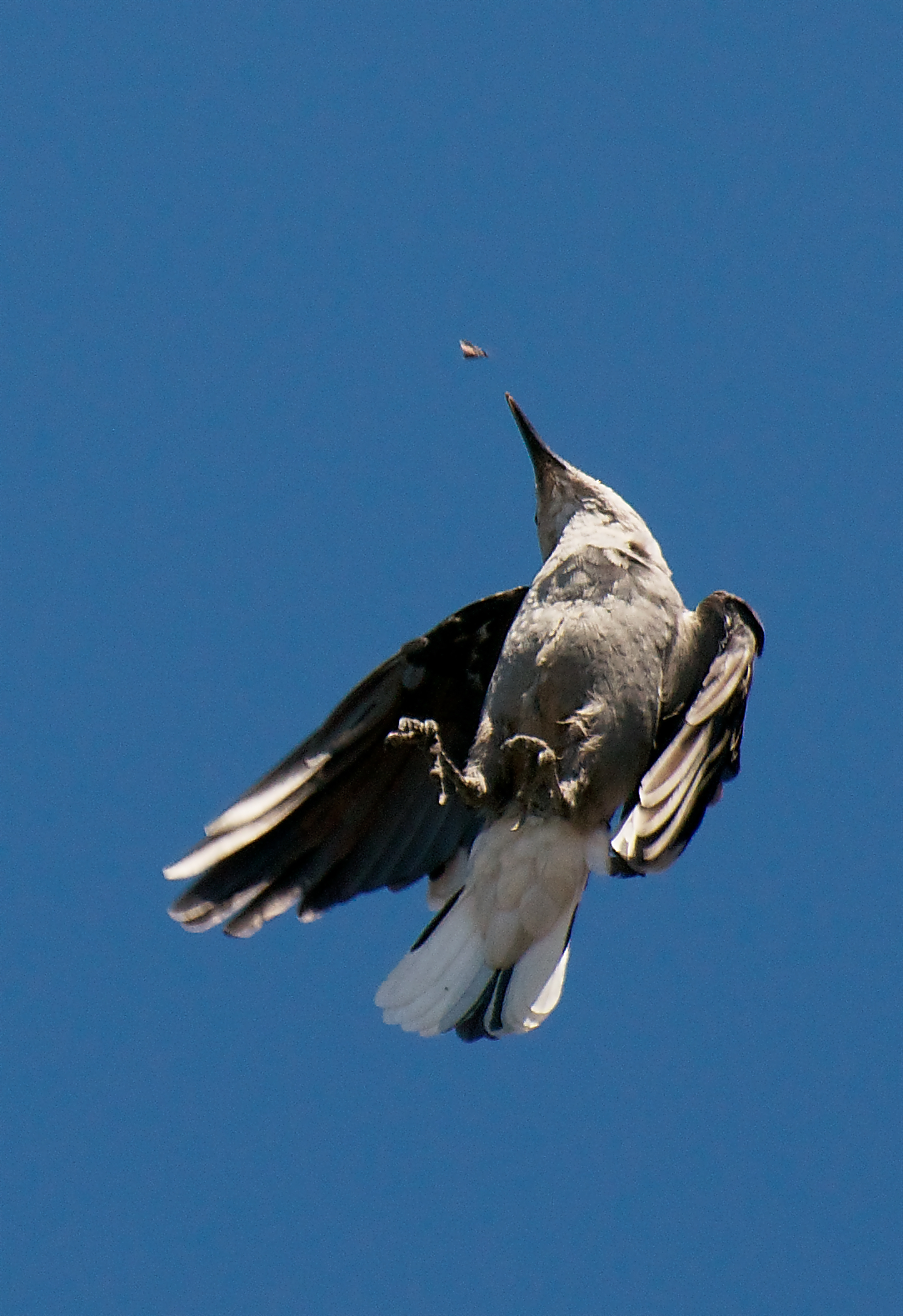
 
At times they would fly out of a tree as if they were fly catching. The one above is definitely in pursuit of something, but it looks more like one of the pine seeds than an insect. I have not found any literature that attributes fly catching to nutcracker's, but they are know to include insects in their diet.

Clark's Nutcrackers are well know for collecting and stashing pine seeds for use during the winter months.  They have incrediable memories allowing them to find the seeds in their many hiding places. Some of the seeds that they don't consume end up sprouting and growing into more trees, making nutcracker's one of the primary means that some pine forests spread.
Here is an account of this behavior from Cornell's All About Birds website:
All year round, the staple food of a Clark Nutcracker’s diet is pine seeds, either fresh or stored. The nutcracker uses its long, sharp, sturdy bill to crack open closed, unripe pine cones and remove seeds from the cone scales. It shells seeds by cracking them in its bill or by holding them in its feet and hammering them. Between September and December it stores seeds to eat later, placing 30–150 seeds in the pouch under its tongue and carrying them to a spot nearby or up to 15 miles away. It digs a trench in the soil with its bill and puts a cluster of seeds inside before covering them up again, or it pushes individual seeds into gravelly soil, pumice, or crevices in wood. During the winter and spring, it relocates caches by remembering where they lie in relation to nearby objects like rocks, logs, and trees. Nutcrackers have such good memories that they can relocate seeds more than nine months after caching them, though their accuracy declines after about six months. They don’t recover all the seeds they bury, and it’s estimated that for some high-elevation pines, such as whitebark pine, virtually all the trees you can see on the landscape come from seeds planted by a nutcracker. Nutcrackers use cached seeds to feed both themselves and their young. Clark’s Nutcrackers also opportunistically eat insects and spiders, and small vertebrates such as other birds, ground squirrels, chipmunks, voles, toads, and carrion.
 
While most of the nutcrackers were above in trees, making getting a full shot of them difficult, I found the one above on the ground near a stream up the mountain from Timberline. I could be totally wrong on this, but I suspect this is a first year bird. For one thing, it was a little tamer than the others, which always makes me suspect a young bird.  Also, its face doesn't have much white like adults.  Unfortunately I couldn't find much information about year old birds, so please feel free to let me know if I am right or all wet.

Friday, August 3, 2012

Cassin's Finch

During the early part of my last trip to Timberline Lodge on July 1st, I spent a fair amount of time shooting Cassin's Finches. They were out in large numbers in the grove of trees northeast of the lodge.
I noticed an area on the east side of the grove that was especially active, so I decided to sit just outside where the morning sunlight would be good. It didn't take long before a few finches started showing up and pretty much ignored me.
The finch above perched so close to me that I had to back off my zoom a little (not something I do very often).  The light was great, the bird was great, resulting in a nice photo.

Monday, July 9, 2012

Gray-crowned Rosy-Finch

A couple of years ago during my first summer of adult birding, I spent some time in Albuquerque, NM on business.  I was lucky to have some time between meetings to do some birding, and even luckier to have Saturday morning free allowing me to tag along with a local Audubon Society field trip up to Sandia Crest in the Sandia Mountains.
I learned from the locals that Sandia Crest is one of the few places that you can find all three species of Rosy Finches in the Winter. A great article about the finches and some young boys that study them had just been included in the latest Audubon Magazine and the local Audubon Society president had a box full of copies to give to each of the field trip participants.
I found these birds and the story to be fascinating, but unfortunately it was June and the birds where off in other parts of the world. I've considered returning to Albuquerque just see them, but until a week ago, I was left to hoping that I would happen upon them elsewhere.

That elsewhere turned out to be Mount Hood, just northwest of Timberline Lodge. I like to hike around Timberline Lodge this time of year as there is still snow, but the ground is beginning to be exposed and the temperatures more tolerable.  There is a thin grove of mountain pines that I find to be quite birdie this time of year and a week ago this past Sunday was no different.  There were Cassin's Finches along with a few Pine Siskins and Yellow-rumped Warblers throughout, singing up a storm.
When I reached the end of the grove, I found a rock to sit on to take a breather. After a few minutes I heard a family approaching so I decided to start moving again. As I gathered my gear, I realized that I was missing my cellphone.  It had been in its case, clipped to my belt, but must have fallen off somewhere earlier.  It was then that I saw a bird land not far from the family and their dog. My heart started to pound because I was fairly sure it was a Rosy Finch. I tried to get my camera ready to take a picture, but between worrying about my cellphone and the dog that was approaching the bird, I was too slow and the bird flew off.

I was bummed! I was pretty sure it was a Rosy Finch, but I only had a distant view and I certainly didn't think I would be able to determine which species. I searched the area in the general direction it had flown, but I could not refind it, so I continued back down the mountain, retracing my tracks in search of my cellphone. Luckily, there was still a fair amount of snow on the ground, so I was able to follow my wondering tracks and eventually found the phone on the ground.
That minor catastrophe averted, I ventured back up the mountain and sat back on that same rock. After about five minutes I heard a chirp behind me. I turned and there, not more than ten feet away, was a Gray-crowned Rosy-Finch perched at the top of broken stump. I carefully gathered my lens, twisted around and started taking pictures. It stuck around long enough to get three nice poses.
One down, two to go. :-)

Thursday, October 13, 2011

Golden-crowned Kinglet

My first Kinglet sighting of the season turned out to be my first Kinglet sighting on Mount Hood and I saw both Ruby-crowned and Golden-crowned together.
There were probably 20 - 30 Golden-crowned Kinglets feasting away in a few pines along with a couple of Ruby-crowned Kinglets. They were tolerant of my presence, probably too intent on feeding, but as usual, they were buggers to photograph. Not only were they in near constant motion, but whatever they were eating was found mostly on the underside of the inner branches as that is where they spent most of their time.
I just stood there, with my camera ready, waiting for one to pause for a moment in the clear. Many shots looked great through the view finder, but were either shot late, poorly exposed, were out of focus or poorly posed. I got several rump shots. :-)
I took around 115 shots and the pictures above were the best of the bunch. Not bad shots, but I was hoping for better considering how close I got and the high number of opportunities I had.
None-the-less, it was great sport!

Wednesday, October 12, 2011

Common Raven

The first bird I saw when I started exploring around Timberline Lodge this past Saturday was a Common Raven calling from the rooftop of the lodge. I was up hill (mountain?) from it as it flew over me and landed at the top of a dead tree not far from where I was standing. It was rather trusting, I suppose it is used to people being around, and hung out for a while posing for me.
It then flew across the path to where a lodge pickup was parked and where another Raven was scavenging on the ground.
Near the pickup was some trash from someone's fast food lunch. For some reason, the Raven found the plastic bag more interesting than the piece of bread next to it. Unfortunately it snapped a piece off with its large beak and then proceeded to swallow it down. Hopefully it will just pass through, but if the piece where big enough, I suppose it could get caught in its digestive tract.

Thursday, March 24, 2011

Gray Jay & Clark's Nutcracker

I took a couple of days off from work since my daughter is home from college for Spring Break. We had planned to make a trip to Mount Hood's Timberline Lodge during Christmas break, but never made it, so we decided to go today.
The idea was to go snowshoeing to take in the sights and see if I could see any interesting birds. The sights were spectacular, even if it snowed most of the time, but the birds were scarce. That didn't surprise me, but I thought there would be more than three species. That's it, only three species. But I'm not going to complain as two were new life birds. In addition to seeing a few crows, we saw a single Gray Jay and three or four Clark's Nutcrackers.
The Gray Jay was first and I saw it very near the beginning of our snowshoeing adventure. It didn't stay around for very long, but I managed to get one reasonably good shot. Then that was it, no more birds until we were getting ready to leave. As were walked to the car some Crows flew over. Then one of the lodge's employees walked by and told us that there had been an accident on the road leading up to the lodge and that they weren't letting anyone use the road until it was cleared.
It was about then that I saw a bird swoop across the parking lot and land at the top of one of the pines. It turned out that there were a few Clark's Nutcrackers flying around the lot in what looked like an effort to scrounge for droppings around the cars. They are supposedly pine nut eaters, but they sure did look like they were scavenging. They would sit at the top of some pines then swoop down between the cars, sometimes perching on top of one as seen above.

The brave adventurers:

Wednesday, September 8, 2010

Cassin's Finch

The only place I have seen a Cassin's Finch is on Mount Hood near Timberline Lodge. Not only is it the only place I've seen them, but I've seen them all three times I've gone birding there. This male was foraging for seeds on the downhill side of the lodge parking lot. Once I saw it, I just stayed in place taking pictures as it kept moving in closer and closer to me.

Tuesday, September 7, 2010

Mule Deer

While I was making my way to the parking lot to leave Timberline last Sunday (seems like something cool happens as I'm leaving fairly often), I walked along the downhill side of the lodge's parking lot. There was some sort of large machine ahead of me along the path. I didn't give it much notice as it was fairly nondescript. Then I realized that right behind it was a large male Mule Deer. It was just standing there on the other side leaving only it's head and top of it's back visible to me. It had a nice sized set of antlers on it as you can see.
It soon noticed me and walked off between the trees, but I got a nice shot of it walking away. My wife really liked the photo and commented that it isn't the view one normally sees of a deer. :-)