Monday, December 13, 2010

Red-tailed Hawk

Another image from my last trip to RNWR last Wednesday. There were raptors galore. I saw several Red-tailed Hawks, several Bald Eagles, a couple of Northern Harriers and American Kestrels. Not only were they plentiful, but they were much more cooportive about staying in place so I could take some good pictures.
The image above is one of those examples. This Red-tailed Hawk was perched in a tree about 10 feet off the ground. I pulled up along side it in my car and started taking pictures. It did not show any concern with my presence. Normally I would have lucky if I could gotten that close without it flying off. I'm not sure why things would be any different other than it was later in the afternoon than when I normally visit.

Sunday, December 12, 2010

Varied Thrush

After spending an hour and a half slowly driving up and down Rentenaar Road looking for the Bobolink, I decided to drive over to Wapato Access Greenway, get out of the truck and walk around a bit. Turned out to be fruitful as I got to see another Varied Thrush and this time I got some reasonable pictures.
The few I've seen have been difficult to photograph as they are weary of humans and tend to take cover high among the branches of surrounding trees. Luckily the trees weren't very tall along the trail so it stayed within range.
I also got to here it vocalize a bit. It made a chirp somewhat reminiscent of a Robin, but much softer.
Based on the pale chest stripe, I assume this Thrush is a female.

Bewick's Wren

It was a rainy, gloomy day today (looks like it may stay that way for a while), but I decided to make a trip to Sauvie Island this afternoon in hopes of seeing the Bobolink reported on OBOL. No luck on that, but I did see several birds, including a lot of Snow Geese. I also saw this Bewick's Wren.

Saturday, December 11, 2010

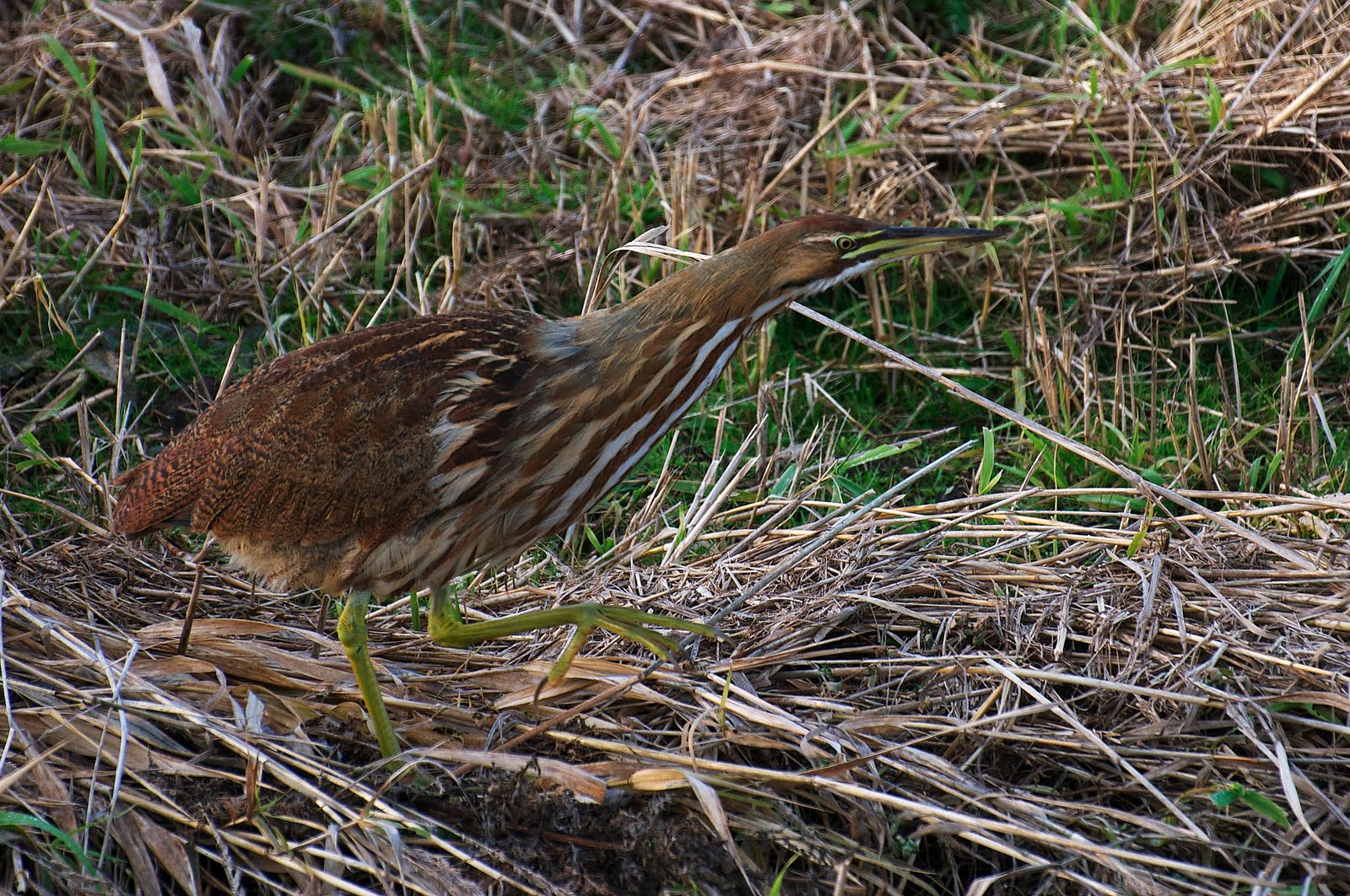
American Bittern

I've only seen one American Bittern in the past and that was at RNWR along the canal after marker 12. So each time I take the auto tour, I'm on the watch for them in that area. Their coloring blends in well with the dried grasses and weeds so they can be easy to miss.
As I rounded the corner entering this area on my last trip, I saw one flying off, so I thought my chance of seeing one that day just flew away, but I actually saw two more along the Canal.
Note the size of their feet. I haven't seen feet proportionally that large since seeing the Common Moorhens in Montreal.

Friday, December 10, 2010

Cackling Goose - Hissing

Some Cackling Geese were standing on the berm around marker 12 of the auto tour at RNWR during my last visit. It was a great opportunity to get some close shots of these geese. As I was shooting the goose above it suddenly got annoyed by another and hissed at it just as I took a shot. They have pretty good sized tongues. Most bird tongues I've photographed are usually thin.

Thursday, December 9, 2010

Great Egret

One of the first birds I saw during my last trip around the RNWR auto tour was this Great Egret. It was stocking some prey in the canal along the road. It was nice to get such a close look as they are typically more flighty than their close relative the Great Blue Heron, but things tend to not be typical at RNWR.

Northern Harrier

I love watching Northern Harriers swooping over open meadows hunting for prey, sometimes hovering momentarily as they look down below. They are so graceful. And you can always tell its a Harrier, even from a distance, because you will inevitably see the large flash of white on their upper-tail coverts.
The Ridgefield National Wildlife Refuge auto tour is a very interesting birding area. You are not allowed to get out of your car during the winter months and this has its pluses and minuses.
On the plus side, even the though the cars are moving (albeit slowly) they tend to act as moving bird blinds. I'm amazed at how close you can get to birds and the quantity you can see.
On the minus side, it can sometimes be restricting trying to take pictures.
The images above demonstrate a bit of both. On the one hand, I got pretty close to this Harrier. On the other, I had to turn my car sideways in order to get a shot and then I wasn't able to move around to get a clearer view of the bird. I've learned to get some shots from where I am before trying to get something better, so after I took these shots I tried to get closer, but it flew away.
All-in-all, it was pretty exciting to get the shots I did.

Tundra Swan - Banded

I have seen various postings of birds that had some type of bands that were visible from a distance, not just the metal bands around the leg. Today, while driving the auto tour at Ridgefield National Wildlife Refuge I noticed that several of the Tundra Swans had neck bands. Some of them were close enough that I was able to get readable pictures.
I remember reading a posting by Greg Gillson that discussed how to report these sightings. I assume these birds have already been reported at this location as it is a popular birding area, but I thought I might as well report it anyway, if for no other reason than for the experience.
I'm not sure what it all means, but they wanted the number, the color of the band and the color of the number. I suppose it provides more combinations without creating a long number that is less likely to be seen or remembered.

Tuesday, December 7, 2010

Tufted Titmouse

During my first trip to Atlanta, I saw my first Tufted Titmice. I got a few pictures, but none of them turned out very well. The Titmouse is another bird that moves around a lot among the bushes and shadows foraging for food.
On my second trip, I saw many more. I also got a lot more bad pictures. The birds were either moving too fast, in the shadows, were heavily back lit or some combination. The three images above are the best of the lot. Not the best, but not too bad either.
An interesting feature is their black eye ring. Most birds have pale eye rings. This dark ring along with very dark eyes makes their eyes look proportionally much larger than most birds. I'm not sure if this is just a coincident or whether it serves some tactical advantage.

Monday, December 6, 2010

Northern Pintail

So what do you do with an image you really like but is poorly exposed? You apply some filters with your favorite image editor and make art.

Before:

and After:
Well, I try anyway. :-)

Golden-crowned Sparrow

While I still see plenty of Song Sparrows, late Autumn seems to be dominated by Golden-crowned Sparrows around here as most sparrows I see are Golden-crowned. While they aren't quite as cooperative as Song Sparrows are in the Spring, they do allow you to get fairly close.
I got two good opportunities at Fernhill Wetlands on Nov 27. First near the grove of trees next to Dabbler's Marsh (top image) and then later in some bushes at the southeast corner of Cattail Marsh.
The darker colors on the crown of the bird in the top image would indicate an adult Golden-crowned Sparrow although I have seen some with more defined crowns, while the paler crown of the bird in the lower two images would indicate a 1st winter Golden-crowned.

American Wigeon

A male American Wigeon seen at Westmoreland Park in Portland on Nov 22. This was one of the many American Wigeons that were hosting the two Eurasian Wigeons.

Sunday, December 5, 2010

Molalla River State Park

For such a great weekend weather-wise, my birding experience was not very good. I don't usually post trip reports, but it seems appropriate based on my experience and the fact that I didn't take many pictures.
I started out on Saturday morning with a visit to Hayden Island to see if I could see some of the ducks that are still being reported there. When I left Wilsonville, it was sunny and mild, but by the time I got to Hayden Island it was cloudy, cold and quite windy.
I first checked out the walkway along the condos where the Western Grebes, Scaups and Scoters have been, but I only found the Western Grebes. I counted about 25.I then went looking for Broughton Beach. I have never been. There have been reports of Horned Grebes and Common Goldeneyes, both of which would be new life birds for me. I did see a very large raft of Scaups, but they were well off shore and at the time I was in my car trying to find a place to park. When I finally did find the small parking lot I ended up seeing very little and the cold wind soon got the better of me. Due to limited time, I eventually decided to give up and go home. Of course by the time I got home the sun was back out. :-(

Today, I decided to try birding Molalla River State Park. I had forgotten that it existed and is only about 15 minutes from my house. The birding wasn't great, but that may be because I didn't get out there until about 2:30. I did get a few decent photos, but nothing to write home about.
There were a few Golden-crowned Sparrows.

Several Dark-eyed Juncos.

A male American Kestrel.


Even though there were many signs stating that dogs must be on leash, there were lots of dogs roaming free. At one point a woman with her off-leash German Shepard started freaking out when her dog started running to another woman's off-leash Rottweiler. Things got a little tense, but they eventually parted way.One dog chased this Squirrel up a tree.

Saturday, December 4, 2010

Double-crested Cormorant

Another image from my Bayocean Spit trip back in Sept. Double-crested Cormorants are one of my favorite birds. There is something about their head, feet and wing and back feathers that give it a prehistoric look.

Friday, December 3, 2010

Canada x Great White-fronted Goose Hybrid

Update:
It's been suggested that the hybrid is too large to be a cross with a Greater White-fronted Goose and is probably a cross with a domestic Graylag. Also, larger Canada Goose subspecies do not breed in the Arctic, the White-fronted's breeding area. Both are good arguments against a Greater White-fronted x Canada Goose cross.

Original Post:
Today I spent an hour during the late afternoon at TRNWR since it was such a nice sunny day. When I got there I stopped by the visitor center to check the water level and see if there was anything interesting in the rising ponds. There were several Canada Geese swimming in the pond at the time and since it is fair distance to the pond I just took a few shots and moved on to the trail.

Tonight while I was going through the the pictures I realized there was apparently a pretty obvious Canada x Greater White-fronted Goose hybrid among the Geese. The group in the image above is lead by a Greater White-fronted Goose. Following, surrounded by three Canada Geese, is the hybrid.
It has the body coloration of a Canada, but its neck is browner and more variable. The white cheek of its Canada influence is almost nearly disguised. To me the most telling characteristics is the pinkish, orange beak and the white feathers at the base of the beak. Both influenced by the Greater White-fronted genealogy.

Thursday, December 2, 2010

Brant?

Back on Sept 11, I made my first (and so far only) trip to Bayocean Spit near Tillamook. It was a gorgeous day and I walked the entire perimeter of the spit. I saw several interesting birds including a few new ones. I started on the beach side and returned on the bay side.
Shortly after making the turn, just as the bay starts for form a beach, I came upon a handful of what appeared to be some strange looking ducks on a very small island just off the beach. I took several pictures and decided they were probably some type of Mallard hybrid. Since I typically identify birds from my pictures rather than in the field, I didn't look as closely at the birds as I might or I would have realized this was probably a bad conclusion.
After moving on further I came upon a large flock of assorted gulls on a large mudflat. I thought to myself, what the heck, I'll walk out and see what I find. It was a bit gooey out there, but I managed just fine. Eventually I noticed some black ducks out on the water which turned out to be my first sighting of Surf Scoters.
In order to get as close to the Scoters as I could, I worked my way out to the waters edge onto some soft sand until I was at the base of a small sand berm that extended into the water. At the end of this berm was a couple more of these strange looking ducks. I sort of ignored them as I was watching the Scoters, but eventually they slowly moved towards me until they were standing right next to me. One them had a bum leg so it hobbled as it moved. I snapped a few pictures and then moved on.
When I got home, I puzzled over these pictures, but could not figure out what they were. Then a couple weeks later I was looking through my copy of Sibley's field guide when I came across the page on Brants. I was unaware of this goose before then and it hit me that although these "duck's" color was off, the general shape was more goose like than duck. The bill was black and small and the legs black. They even had the remnants of a white band around their upper neck. Though the coloring was brown and mottled, it otherwise was fairly consistent with a Brant. The other characteristic it exhibited was either a rather severe case of feather wear, molting or both. However at the time, I still wasn't convinced.
Well I've been thinking about those pictures recently and took another look at them tonight. I'm more convinced now that they are Brants, so I've decided to post them.
I welcome comments on whether you agree or disagree with my conclusion. I also welcome comments on the state of their feathers and the coloration.

Wednesday, December 1, 2010

Northern Flicker - Female

Low light and distance typically result in noisy images and these are no exception, but I really like this bird. The red under its tail jumps out more than most I see and its overall coloring is very pleasing.

Tuesday, November 30, 2010

Bushtit

I was going through some pictures of Bushtits I took back on the 12th at TRNWR. Most were the inevitable blurred feathers and empty branches as I tried to keep up with the birds.
The picture above caught my attention, not so much because it is such a good picture, but for the interesting look in the Bushtit's eye. Kind of sinister. Probably due more to the angle that its attitude, but she does have a look of "don't mess with me" about her.

Northern Pintail

When I started birding last March I saw very few Northern Pintails. Recently, however, I find them in high numbers in virtually all areas where water fowl hang out. It will be interesting to see if their numbers reduce as this coming March approaches.

Monday, November 29, 2010

Ring-billed Gull

A more obvious Ring-billed Gull than what I posted in the past. Though I've only visited it once, Westmoreland Park appears to be a great place to get close shots of a variety of gulls.

Saturday, November 27, 2010

Hooded Merganser - Female

I found this female Hooded Merganser at Ridgefield National Wildlife Refuge on Friday just past the blind in the stream on the right side of the road. I had to maneuver my car a bit to get a clear shot through the branches.
I've never seen a Hooded Merganser out of the water. I am surprised at the size of the body, legs and feet. They seem so much smaller and sleeker in the water.

Great Egret

Another dreary day in the Pacific Northwest. I spent the morning at Fernhill Wetlands. The activity was a pretty good, but the Common Mergansers drove me crazy. Try I as I did, I could not figure out a way to get in close to them to get good pictures. It's wide open at Fernhill and the ducks see you coming from a ways off. As soon as you start towards them they just start swimming to the center of the pond or to the other side. Very frustrating. I considered crawling on the ground, but I decided to hold on to what dignity I still have left. :-)
All was not lost however as I did get some good pictures of some Golden-crowned Sparrows, some Lesser Goldfinches and the Great Egret seen above. This Egret has been perching in the trees in this same area for a few weeks and seems less afraid up there allowing for some reasonable pictures.