Wednesday, November 24, 2010

Yellow-bellied Sapsucker

Not a new bird for me, but I got the best views and pictures of a Yellow-bellied Sapsucker on my last trip to Atlanta. Woodpeckers (as well as Brown Creepers) can be difficult to shoot as they are typically working their up a tree truck or branch. It hard to keep up with them and hard to get a good look at their face.
The Sapsucker in the images above is a female as it lacks red feathers on its throat.

Tuesday, November 23, 2010

Red-bellied Woodpecker


During my last trip to Atlanta I got a better picture of a Red-bellied Woodpecker.

House Sparrow

While watching the ducks on the Columbia River from Hayden Island, I came across a small flock of House Sparrows in some shrubs. I've never shot a House Sparrow yet even though they are very common. I guess it's because they typically hang out in cities around here and I usually bird in more rural areas.
Anyway, they were quite close so I took the opportunity to snap a few pictures. The male's face and breast where not as black as they would be during the breeding months. They're really rather pretty birds, but get overlooked because of they are so common and are considered somewhat of a pest.

Monday, November 22, 2010

Eurasian Wigeon

I'm on vacation this week, so I thought I'd get some birding in this morning before the bad weather settles in. I went to Hayden Island for the first time to see if I could see the White-winged Scoters that had been reported. I found them, but they weren't very close to shore, so my pictures didn't turn out very well. Same goes for the Surf Scoters, Western Grebes, Lesser Scaups and a Common Loon.
I then decided to go to Westmoreland Park for the first time. Fellow blogger Jen had seen some Eurasian Wigeons there about a week ago and since my only sighting was from quite a distance I thought I'd try my luck. My luck turned out good as I found a male and female pair among many American Wigeons. They are a very pretty birds.

Saturday, November 20, 2010

Brown Thrasher

Coincidentally, I made my second business trip in four weeks to Atlanta this past week. Last time, I had a free day and visited Olmsted Park and Fernbank Forest. This time I spent some time at Chattahoochee River National Recreation Area—Cochran Shoals Unit.
It was a very nice day and the trail along the river was very active with birds even though it was heavily used by joggers and walkers. The trail was actually a light-use gravel road used by service vehicles, so there was plenty of room for everyone and the birds didn't seem to mind all the people. Interestingly enough, when I left this trail and ventured into the more forested areas of the park, my bird sightings went way down.
I saw many of the same birds I saw last time; Carolina Wrens, Carolina Chickadees, Tufted Titmice, Red-bellied Woodpeckers, Blue Jays and Northern Cardinals. New birds this time included a Brown Thrasher and a juvenile Red-headed Woodpecker.
The Brown Thrasher above is the first I've seen since I was young back in Minnesota. Most of the time it was foraging on the ground in among the brush where I could only get glimpses of it. At one point though, it did come out and spend a little time on a branch above me so I could get a few pictures of it.

Thursday, November 18, 2010

Caspian Tern

A couple of images of some Caspian Terns on the beach at South Jetty in Fort Stevens State Park back in late August on a 'sunny' day.
My son taught me how to use the clone tool in my image editor a few weeks ago. I used it on both of these images to clean them up a little. I took out 3 birds (2 gulls and a tern) in the top image and a single tern and some shadows in the bottom image. It works well with water and sand. Not so well with vegetation. Let me know if it is noticeable.

Wednesday, November 17, 2010

Fox Sparrow

While waiting for the Painted Bunting to show itself at Seaside this past Sunday, I saw my first Fox Sparrow. That's right, I've never seen one before. I always thought it odd that I wasn't seeing any as I don't think they are uncommon here. So while I struck out on the Painted Bunting, I did see a new bird while trying which is always a thrill.

Delma Ann

I found this rigging rope from the Delma Ann laying on the beach while birding on Sunday at South Jetty in Fort Stevens State Park. Think they want it back? :)

Tuesday, November 16, 2010

Bonaparte's Gull

I decided several months ago that cloudy weather wasn't going to stop me from taking pictures of birds. You often end up with less than ideal photos, but you sometimes get some great ones (soft lighting has its advantages). And besides, when you live in the Pacific Northwest, you'd be missing a lot of days if you waited for sunlight, especially in the Winter.
Such was the case this past Sunday. A cloudy, foggy, gloomy, misty day. But I was able to get some pictures of a new life bird; the Bonaparte's Gull seen above. This was an especially bad day, but I've found that if I underexpose by as much as a full stop that I gain a couple of advantages. One, I gain a stop in shutter speed which helps with focus. And two, my camera's metering system tends to overexpose in these lighting conditions. The pictures will turn out somewhat dark, but that can be corrected in post. The pictures still aren't as good as they would be with full sunlight, but usable.
The top image is of an adult and a 1st Winter Bonaparte's. The adult is in the lead and is determined by the white outer primaries and white tail. The trailing 1st Winter is determined by the dark outer primaries, dark patches on upper wing and black tips on its tail feathers. This is one gull that is fairly easy to identify, however I briefly thought it might be a Black-headed Gull which would have been very cool as it is very rare, but its reddish bill and dark under wings did not match this bird.

Monday, November 15, 2010

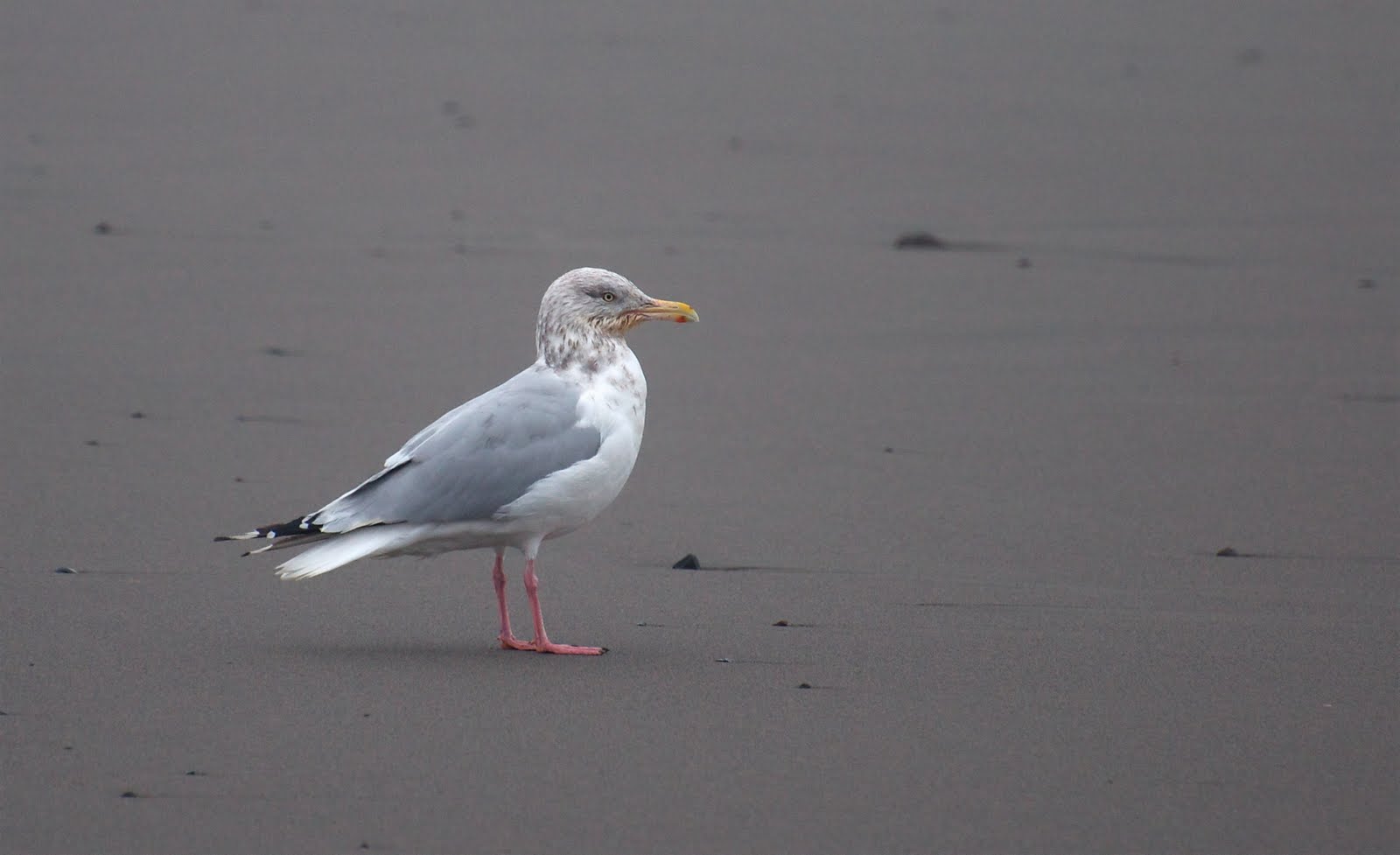
Herring Gull

I have a terrible time identifying gulls. I'm not alone as they are very difficult to ID since there are many that are very similar and some that cross-breed.
I spent some time at the coast on Sunday. I stopped for about an hour and a half at Seaside in hopes of seeing the Painted Bunting that has been reported on OBOL, but did not have any luck. I then spent a couple of hours at South Jetty in Fort Stevens State Park.
It was cloudy, foggy and gloomy and the birds scarce, but I did see a new bird; the Bonaparte's Gull. I also am 90% I saw a Western Meadow Lark.
The Bonaparte's Gulls were among a flock of gulls on the beach. The flock appeared to be made up of mostly Westerns, however the one above looked different. I have incorrectly identified a Western and a Western x Glaucous-winged as Herring Gulls in a couple of past posts, however I think I got it right this time. Please feel free to let me know one way or the other if you agree.

Saturday, November 13, 2010

Golden-crowned Sparrow

It's interesting. TRNWR has been relatively quite for some time. It's still been a great place for birding, but once Summer came, activity went way done. Then we moved into the Fall I had hopes of seeing a lot of migrants, but that didn't seem to be the case. Now, in the last week, the place seems to be coming alive again.
I found the Golden-crowned Sparrow above in the same Blackberry bushes as the House Finch I posted yesterday.

Friday, November 12, 2010

House Finch

It was a gloomy day at TRNWR over lunch today, but the birding was pretty good. There was a large flock of House Finches just before the grove with the first bridge. The one above broke away from the group and landed not far from me on some Blackberry bushes.

Golden-crowned Kinglet

Since seeing my first Golden-crowned Kinglet on Sept 30th, I have been seeing them regularly. It's interesting as they are listed at TRNWR as year-round uncommon visitors.
Regardless, trying to get a descent picture of them can be great sport. They are small, constantly moving and like to hangout in among branches so they are regularly obstructed.
But today I got lucky. Not only did one land in some branches very close to me, but it hung around long enough for me to take several pictures and held still long enough for me to take the image above. Most of the pictures were blurry as getting good focus is difficult as there is usually a nearby branch that my camera's auto-focus system decides is the subject. Luckily, my camera has a mode that does an initial auto-focus and then allows me to make manual adjustments. That works reasonably well, but you have to be quick.
Anyway, this is a very pretty bird and is fun to watch. Many times while jumping around from branch to branch it will hover in the air similar to a hummingbird. That would make a great picture.

Thursday, November 11, 2010

Eurasian Wigeon

Another case of not knowing what I had until I got the images on my computer. I knew this duck looked different, but it was quite a distance from me, so I couldn't identify it. Actually, had I been much closer I still wouldn't have know what it was, but at least I would have known for sure that it was a new bird for me.
I saw these yesterday at TRNWR on the main pond near the visitor center. I've been checking the water levels from the visitor center overlook recently since they raised the drains. A small amount of water has collected in the deepest areas and ducks are starting to frequent it. It's mostly been Northern Pintails, a few American Wigeons and Mallards.
The duck on the left is definitely a Eurasian Wigeon. I'm not sure about the one on the right. I thought it was a female, but it has a rather large patch across its eye. It may be a pale male American Wigeon. Whatever the case, they were swimming together.
There is a little more green around the left duck's eye than both Sibley and Cornell show, for a Eurasian but not nearly as much as Sibley illustrates for a Eurasian x American Wigeon hybrid. A search on the web returns many pictures of Eurasian Wigeon with at least the amount of green that this one has. So it may be a pure bred.

Wednesday, November 10, 2010

Western Screech-Owl

Tualatin River National Wildlife Refuge was were I started taking pictures of birds back in March and I've visited it many times since. On a few occasions someone would pass me on the trail and ask me if I had seen the owl. In all this time, I have never seen the owl. Until today.
I was walking through the forested section just before the bridge to the wetlands observation deck at the railing overlooking the creek looking for some Kinglets or Nuthatches, as they are common through this area lately, when suddenly, there it was, right in front of me.
It was perched on a Cedar branch, snuggled up to the trunk, not more than 10 or 12 feet off the ground. It blended in well with its surroundings and was fast asleep. I was surprised at how small it was. I had expected something much larger and further up in the tree.
I'm not sure if this was "the" owl, but it was about where I had been told to look for it and I found a picture of a Screech-Owl on the "Friends of the Tualatin Refuge" sitting on what looks like the same branch. It kind of makes me wonder how many times I may have walked right past it.
It was sleeping the whole time I was taking pictures of it, only opening one eye slightly to take a peek about the time I moved on, so I didn't get a chance to see its eyes. Maybe another day.

Tuesday, November 9, 2010

American Goldfinch

I looked at this one for long time. In the Summer, American Goldfinches are obvious, especially males. But as winter comes, they molt and the bright colors of Summer fade into pale yellows and browns. As I see it, there isn't a lot of difference between it and a Lesser Goldfinch during this season.
I've seen more obvious American Goldfinches at Fernhill Wetlands regularly this fall. Just last week I saw some that seemed to me to be obvious. But this one is brighter yellow than those I've seen. Even so, since I don't see any white spot at the base of its primaries, I'm going to tilt the scales towards an American. If anyone disagrees, I'd love to hear why.

Monday, November 8, 2010

Albino? Goose

Update:
The consensus by several on OBOL, is that the white goose is a domestic Graylag. The two pure breed Canada Geese are Westerns and the center Canada Goose is a hybrid between a Western Canada Goose and a Graylag.
Thanks to all the commented.

Original Post:
It was suggested by Wilson Cady on OBOL that the domestic goose may be an albino. Quote "I blew your photo up to 1,000 percent and (although blurry) the fleshy parts of the bird appear to be pink including around the eyes. The build of the bird and head profile look about the same as the other birds in the flock leading me to think it is a true albino and that the other bird is one of it's clutch mates is showing some signs of that genetic trait. A domestic type goose's genes would mostly change the body, bill shape and head profile of the Cackling Goose parent."

While an albino didn't cross my mind, it did bother me that the goose was rather slender looking. Most domestic geese are blocky and have hanging bellies. Wilson is right about the pinkishness. I missed that, but the bill and legs both look more pink than the orange you would expect from a domestic goose.
This image shows the under side of its left wing and you can see there is one black feather. I'm not sure if this proves anything one way or the other.

Hybrid Goose

For those that frequent Fernhill Wetlands, you expect to be greeted by the hybrid Mallards that hang out near the parking lot. These birds are the result of cross breeding between some resident white domesticated ducks and wild Mallards. They produce quite a variety of blotchy, multicolored offspring.
Yesterday I came across another hybrid water fowl; a hybrid Canada or Cackling Goose. When I took this picture, I thought the white goose was a Snow Goose as I had seen a couple with a large flock of Cacklers a couple of weeks ago. But when I viewed the images tonight, I realized that it must be a domestic goose as its wings are missing the black primaries of the Snow Goose.
Then I noticed something else. If you look at the goose in front of the white domestic goose, you will notice that the white cheek patch is large and smudged looking. Even closer examining reveals that its legs have an orange tint. After some internet research it is apparent that this is a hybrid.
I'm still not very good at differentiating between Canada and Cackling Geese while in flight, but I think the goose in the lead is a Canada Goose and the trailing Goose is a Cackling Goose. I base this on the smaller size and shorter neck length of the trailer. I'm guessing that the Cackler and the domestic goose are the parents of the hybrid.

Sunday, November 7, 2010

Red-bellied Woodpecker

While in Atlanta a couple of weeks ago, I had three sightings of a Red-bellied Woodpecker, two of which I was able to some photos. The first was at Olmsted Park. I only got a quick glimpse of it through my camera lens, but it was enough for me to be pretty sure of its identity.
Then later I got a much better view as seen in the upper two images above. It was fairly high up in the tree and had a bright canopy of rear lit leaves in the background, but I managed to get images that allowed a positive identification.
Finally, I got some closer, less obstructed views as seen in the bottom image, but I could never get a shot of its face. I did, however, get a good shot of its back.
There are times that the only way I have been able to identify a difficult bird is via bits and pieces of it obstructed by leaves and branches in multiple images, but the sum total of all of them gives me enough information to identify the bird. That was not the case here, but the combination of images gives a more complete representation of its physical characteristics.

Saturday, November 6, 2010

Anna's Hummingbird?

I visited Oaks Bottom Wildlife Refuge in Portland for the first time today. I started out at Crystal Springs Rhododendron Garden thinking that there may be wintering ducks, but there mostly Mallards and Wood Ducks along with a few American Wigeon and a few Buffleheads on the far side of the large pond. So I only spent about a half hour there and then decided to try Oaks Bottom since it was close and I was limited for time.
Things were fairly slow there too, but I did run into a couple of active areas. In one of these spots, I saw a mixture of Ruby-crowned Kinglets (one showing its bright red crown very nicely), Brown Creepers, Bewick's Wrens and this one Hummingbird I believe to be an Anna's. There is not a lot of difference in Hummingbirds. I believe Anna's and Rufous Hummingbirds to be the most common around here. This one does not appear to have much, if any, rufous coloring which rules out a Rufous or even an Allen's. The dark patch on the bottom image up above also points towards a female Anna's. If there had been any sun shining today, that spot may have shown some iridescent red.

Friday, November 5, 2010

Killdeer

What a difference it makes when you can get in close to the subject. I took these images back on August 22 at Fernhill Wetlands. It was the day I saw my first Red-necked Phalarope. I had walked down the bank to get in closer to the Phalarope and a Western Sandpiper. Both where being very cooperative. While shooting those two, a couple of Killdeers walked in even closer.

Wednesday, November 3, 2010

Song Sparrow

When I first resurrected this hobby early last Spring, I'd typically always get pictures of Song Sparrows. They would be so busy singing that they would let me get quite close and I was able to get many great pictures.
Then came Summer and later Autumn and Song Sparrows kinda went under cover. When I do see them, they are typically down in the grass out of sight. I know they are around though as I hear them. Not the glorious song of Spring but a single chirp. It took me a while to realize that the chirp was a Song Sparrow, but I now recognize it without having to see the bird.
The image above was taken last Saturday at Fernhill Wetlands. It was a very gloomy, overcast day so many of the pictures I took have a lot of background noise. This one is better than most and I was happy to have a Song Sparrow pose for me again.

Tuesday, November 2, 2010

Eastern Phoebe

I'm always a bit unsure when it comes to Flycatchers, but after researching this one for a few days, I'm pretty sure it is an Eastern Phoebe. The thing that concerns me is that I did not notice either of the birds I saw bobbing its tail as is described in just about every discussion on its behavior. Nonetheless, an Eastern Phoebe does seem to be the best fit in all other categories.
The bird in the top two images was the first bird I photographed on my birding outing in Atlanta. There was a nice clearing as I entered Olmsted Park and the Phoebe was sitting on a branch as if to welcome me to the park.
I saw another one in Fernbank Forest at the small pond. It spent a lot of time fly catching over the pond from the fence it is perched on in the bottom image.